Child Resistant Closure Development: Designing CR Caps as Part of a Complete Packaging System
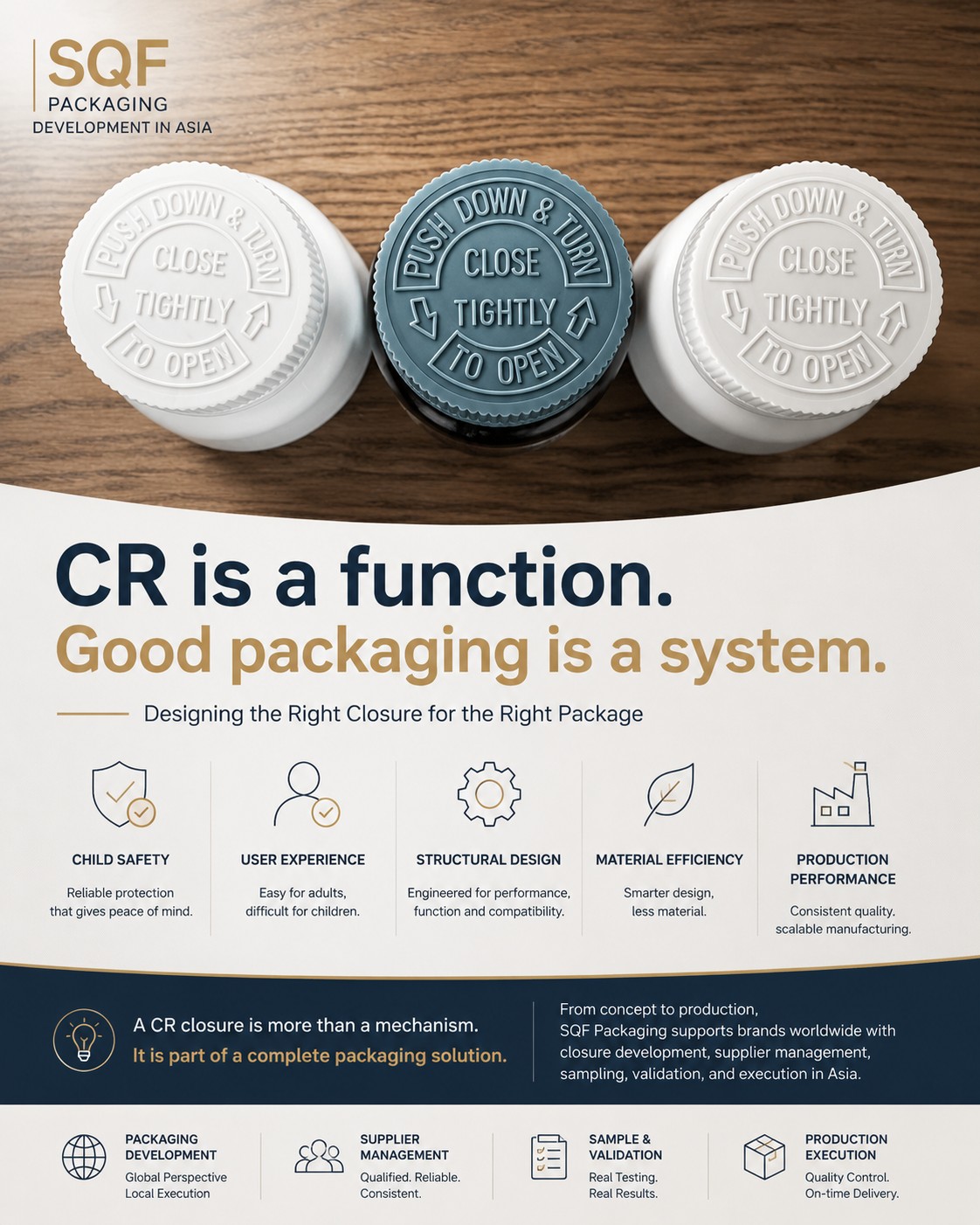
CR is a function. Good packaging is a system.
Child resistant (CR) closures have become an important packaging solution for products requiring additional safety protection, including pharmaceuticals, nutraceuticals, cannabis, household products, and other regulated categories.
However, developing a successful CR closure is not simply about finding a cap that passes a child-resistant test.
The real challenge is designing a closure system that works together with the complete package.
A successful CR closure must balance:
- Child-resistant performance
- Adult usability
- Structural design
- Material efficiency
- Manufacturing consistency
Because a closure is not an isolated component.
It is part of the entire packaging system.
What Is a Child Resistant Closure?
A child resistant closure (CR closure) is a packaging closure designed to reduce the possibility of accidental opening by children while maintaining accessibility for adults.
Common CR mechanisms include push-down-and-turn systems and other safety mechanisms designed according to regulatory requirements.
While the safety function is essential, modern packaging development requires more than compliance.
Brands increasingly need packaging solutions that also consider:
- Consumer experience
- Sustainability goals
- Production efficiency
- Brand appearance
- Compatibility with existing containers
Why CR Closure Development Starts with the Package, Not the Cap
A common approach is to start by selecting an existing CR cap and trying to match it with a container.
However, many packaging projects require a different approach.
The container design may already be defined:
- Bottle or jar shape
- Neck finish
- Product requirements
- Filling process
- Brand appearance
In these cases, the challenge is not:
“Which CR cap can fit this package?”
The real question is:
“How can we design the right closure for the right package?”
The closure must work together with the container structure, sealing system, application equipment, and user expectations.
The Key Factors in Custom CR Closure Development
1. Child Safety Performance
The primary purpose of a CR closure is to provide protection against accidental access by children.
However, safety performance must remain consistent not only during laboratory testing, but also throughout real-world use.
2. User Experience
A package must also work for its intended users.
A well-designed CR closure should balance:
- Secure protection
- Comfortable opening force
- Clear opening instructions
- Repeatable performance
Safety should not create unnecessary difficulty for adult consumers.
3. Structural Design and Lightweighting
A traditional approach to achieving safety performance may involve adding more components or material.
Modern packaging development is moving toward smarter structural solutions.
Through optimized design, CR closures can achieve:
- Reduced material usage
- Better ergonomics
- Improved functionality
- Lower environmental impact
The goal is not a more complicated closure.
The goal is a better-engineered closure.
4. Closure and Container Compatibility
A CR closure cannot be evaluated independently from the container.
Important factors include:
- Neck finish compatibility
- Thread design
- Sealing performance
- Torque requirements
- Application process
A closure that performs well on one container may not deliver the same results on another package.
5. Production Consistency
A successful packaging concept must work beyond prototypes.
During scale-up, attention must be paid to:
- Mold consistency
- Dimensional control
- Assembly performance
- Application process
- Quality validation
The final goal is reliable performance from the first production batch to millions of units.
Why Customized CR Closures Are Becoming More Important
As more product categories adopt safety-focused packaging, brands are looking for solutions beyond standard closures.
A customized CR closure can help brands achieve a better balance between:
- Required safety performance
- Product differentiation
- Lightweight packaging goals
- Existing container design
- Manufacturing requirements
Customization is not only about appearance.
It is about creating the right function within the right packaging system.
How SQF Packaging Supports CR Closure Development in Asia
SQF Packaging supports brands with packaging development and supply execution in Asia.
Our support includes:
- Custom closure development
- CR cap sourcing and evaluation
- Container and closure compatibility assessment
- Supplier qualification
- Prototype coordination
- Sample validation
- Production execution
From concept development to production, SQF Packaging helps brands bridge packaging design requirements with reliable manufacturing execution.
Frequently Asked Questions (FAQ)
Can an existing bottle be used with a child resistant closure?
Yes, but compatibility must be evaluated. Neck finish, dimensions, sealing requirements, and application processes all affect CR closure performance.
Is a certified CR cap always the best packaging solution?
Not necessarily. Certification confirms safety performance, but a successful packaging solution also needs to consider usability, manufacturing, sustainability, and product requirements.
Why develop a custom CR closure instead of using a standard cap?
A custom CR closure may be required when brands need to combine safety requirements with specific container designs, user experience goals, or production requirements.
What does SQF Packaging provide for closure development?
SQF Packaging provides packaging development support in Asia, including closure evaluation, supplier coordination, sampling, validation, and production execution.
Conclusion
Child resistant packaging is not only about preventing access.
It is about designing a complete packaging system where safety, functionality, sustainability, and manufacturing performance work together.
CR is a function.
Good packaging is a system.