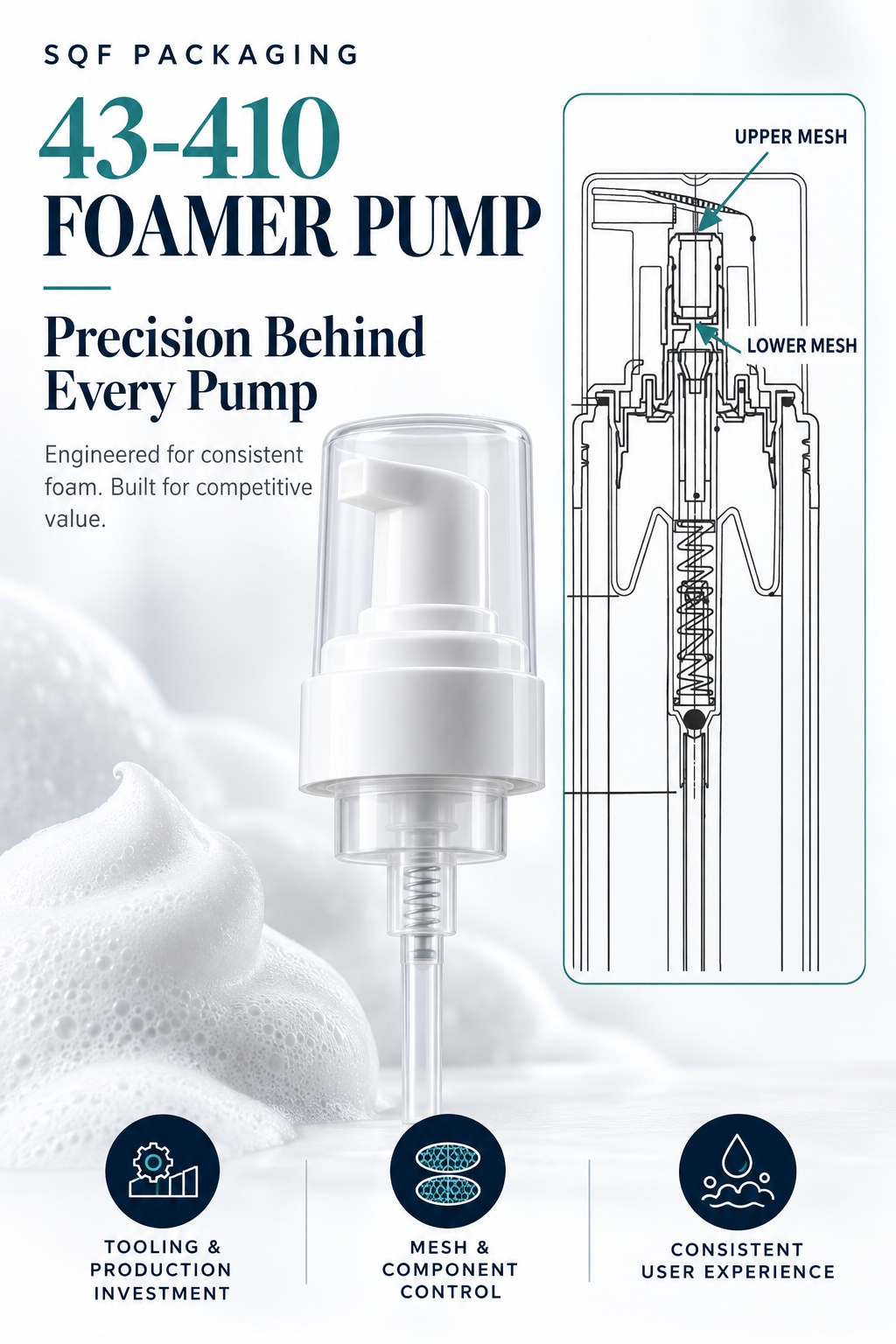
What Makes a Good Foamer Pump? The Details Behind Consistent Foam
A foamer pump may look simple from the outside. But inside, several components must work together to turn a liquid formulation into smooth, consistent foam.
For brands and distributors, a good foamer pump needs to do more than produce foam. It should feel comfortable to use, perform consistently and offer competitive value.
At SQF Packaging, we believe that understanding how a pump works is the foundation for delivering better quality and better value.
How Does a Foamer Pump Work?
A foamer pump brings liquid and air together inside the pump.
When the actuator is pressed, liquid and air are pushed into a mixing area. The mixture then passes through one or more mesh screens, which help create smaller bubbles and a more uniform foam.
When the actuator is released, the pump resets and draws in liquid and air for the next dispensing cycle.
The result is foam created at the moment of use, without the need for an aerosol propellant.
Why Does the Mesh Matter?
The mesh is a small component, but it has a major influence on the foam.
Some foamer pumps use an upper and a lower mesh screen within the foaming assembly. Their opening size, material and assembly affect how the air and liquid mixture passes through the pump. These details can influence bubble size, foam texture, dispensing resistance and overall consistency.
A finer mesh can help produce finer foam, but finer is not always better. If the mesh creates too much resistance for a particular formulation, the pump may feel harder to press or become more susceptible to clogging.
The right choice depends on the complete system—including the formulation, the air-to-liquid ratio and the pump design.
Foam Quality Is More Than the Mesh
Consistent performance also depends on several other factors:
-
Air-to-liquid ratio: The balance between air and liquid affects the volume and texture of the foam.
-
Formulation compatibility: Viscosity, ingredients and the formulation’s ability to foam can all influence the result.
-
Component precision: The fit of pistons, valves and other parts affects sealing, priming and dispensing consistency.
-
Assembly quality: Even a well-designed pump needs consistent assembly to perform reliably in production.
That is why a foamer pump should be evaluated with the actual customer formulation—not with water alone.
The SQF Packaging Approach
At SQF Packaging, we believe that product knowledge and manufacturing efficiency should work together to create better value for customers.
We have invested in foamer pump molds and production lines, allowing us to focus on the details that influence both performance and cost. From mesh selection and component fit to production and assembly, we look for ways to improve efficiency while maintaining the quality and user experience customers expect.
43-410: A Practical Example
Our 43-410 foamer pump is one example of this approach in action.
At a time when resin prices have been rising, we have worked to control costs through our investment in tooling and production, as well as our focus on manufacturing efficiency. As a result, we have been able to maintain—and in some cases lower—the price of this product while continuing to focus on consistent foam quality and a comfortable dispensing experience.
The result is a 43-410 foamer pump designed to offer an exceptional balance of performance, reliability and price.
We also maintain finished-product stock in 43-410 and 40-400 to support customer demand.
Frequently Asked Questions
How does a foamer pump create foam?
A foamer pump combines air and liquid inside the pump. The mixture then passes through one or more mesh screens, helping create a more uniform foam.
How does the mesh affect foam quality?
The mesh opening size and configuration can influence bubble size, foam texture and dispensing resistance. The best choice depends on the formulation and the overall pump design.
Is a finer mesh always better for a foamer pump?
No. A finer mesh may help create finer foam, but it can also increase dispensing resistance or clogging risk with some formulations. The pump should be tested with the actual product.
How does SQF Packaging control foamer pump costs?
SQF Packaging has invested in foamer pump molds and production lines and focuses on component design, production and assembly efficiency to manage costs while maintaining product performance.
Does SQF Packaging offer a 43-410 foamer pump?
Yes. SQF Packaging offers a 43-410 foamer pump and maintains finished-product stock in this size. Contact us to discuss specifications and availability.
Looking for a foamer pump for your next project? Contact SQF Packaging to discuss your formulation, specifications and volume requirements.