How to Source Child-Resistant Caps and Closures: A Buyer’s Checklist
Sourcing a child-resistant cap can look straightforward.
Find the size.
Choose a color.
Ask for a price.
In practice, that is rarely enough.
A successful child-resistant closure project involves more than finding a supplier that already has a CR cap in its catalog.
The closure needs to match the bottle neck finish, provide the right sealing system, work with the intended product and filling process, and perform consistently when moved from samples into production.
So before sending your next RFQ for a child-resistant cap or CR closure, here is a practical checklist of what buyers should consider.
1. Start with the Bottle — Not the Cap
A common sourcing request begins like this:
“We need a 28mm CR cap.”
But nominal diameter alone is not enough to identify the correct closure.
Two bottles described as 28mm can have different:
- thread configurations
- finish heights
- sealing surfaces
- neck dimensions
- closure engagement requirements
The better starting point is the bottle or neck-finish drawing.
If a technical drawing is unavailable, physical production samples can be used to evaluate potential closure matches.
Buyer checklist:
✓ Bottle drawing available
✓ Neck finish identified
✓ Bottle material confirmed
✓ Physical samples available if needed
2. Check Existing CR Closure Tooling First
Before discussing a new mold, ask a simple question:
Does a suitable CR closure already exist?
Child-resistant closures are available in many sizes and configurations. Depending on the application, existing tooling can often be found for common nominal sizes such as:
20mm, 24mm, 28mm, 32mm, 38mm, 44mm, 53mm, 62mm, 68mm and 89mm.
Using an existing closure platform can potentially reduce:
tooling investment, development time, initial MOQ and sampling lead time.
This is particularly valuable during an early-stage project where annual demand has not yet been fully established.
Custom tooling still has its place — particularly when the package requires unique geometry, branding or functionality — but it does not always need to be the first option.
3. Don't Assume the Liner Is a Minor Detail
Once the closure fits, the next question is:
How will the package seal?
Depending on the bottle and application, liner options may include:
- PE foam
- F217-type foam liners
- pressure-sensitive liners
- induction-seal liners
- other application-specific sealing constructions
The correct liner depends on several factors, including the container material, product, sealing requirement and filling process.
For example, an induction liner needs to be selected for the appropriate container substrate and used with a suitable induction-sealing process.
A closure specification should therefore include more than:
“28mm black CR cap.”
The liner or sealing system should also be defined.
4. Tell the Supplier What the Package Will Contain
You do not necessarily need to provide a confidential formulation during the initial RFQ.
But the supplier should understand enough about the application to identify potential compatibility concerns.
Useful information can include whether the product contains or involves:
oil, alcohol, fragrance, solvents, acids, moisture or other potentially relevant ingredients.
The intended application also helps determine what questions should be asked about the closure and liner.
A CR cap for a dry product may have different sealing requirements from one used for a liquid formulation.
5. Define the Actual Volume
MOQ is important.
But annual volume can be even more useful during sourcing.
Suppose a project needs 10,000 pieces for the first order but may consume 250,000 pieces annually.
That information can change the sourcing strategy.
An existing stock mold may make sense for the initial launch, while higher annual volume may justify additional customization later.
When requesting a quotation, consider providing both:
Initial order quantity + Estimated annual volume
This gives the supplier a better basis for evaluating tooling, production method and pricing.
6. Request Samples Before Committing to Production
A drawing comparison is useful.
A physical sample is better.
Before moving into volume production, the proposed bottle + closure + liner combination should be physically evaluated.
Depending on the project, sample evaluation may include:
- thread engagement
- fit
- application torque
- removal torque
- liner compression
- sealing
- leakage
- closure operation
- product compatibility
When possible, testing should use the actual production bottle rather than relying only on nominal neck specifications.
7. Don't Confuse “Fits” with “Approved”
A cap can screw onto a bottle and still require further evaluation.
This is particularly important with child-resistant packaging.
The closure mechanism, bottle finish, liner and application conditions work together as a packaging system.
Therefore:
Fit is a development milestone — not final approval.
Before production, define what constitutes an approved sample and keep that configuration as the reference for subsequent manufacturing and inspection.
8. Understand What “CR Tested” Actually Means
If a supplier says a closure is child-resistant tested or provides related documentation, ask what exactly was evaluated.
Useful questions include:
- Which closure was tested?
- Which bottle was used?
- What neck finish was involved?
- What liner or sealing configuration was used?
- Which test method or standard was followed?
- Does the documentation apply to the package you intend to use?
A CR closure should not automatically be assumed to make every bottle using it a compliant child-resistant package.
Where formal compliance is required, the applicable requirements for the complete package and intended market should be determined.
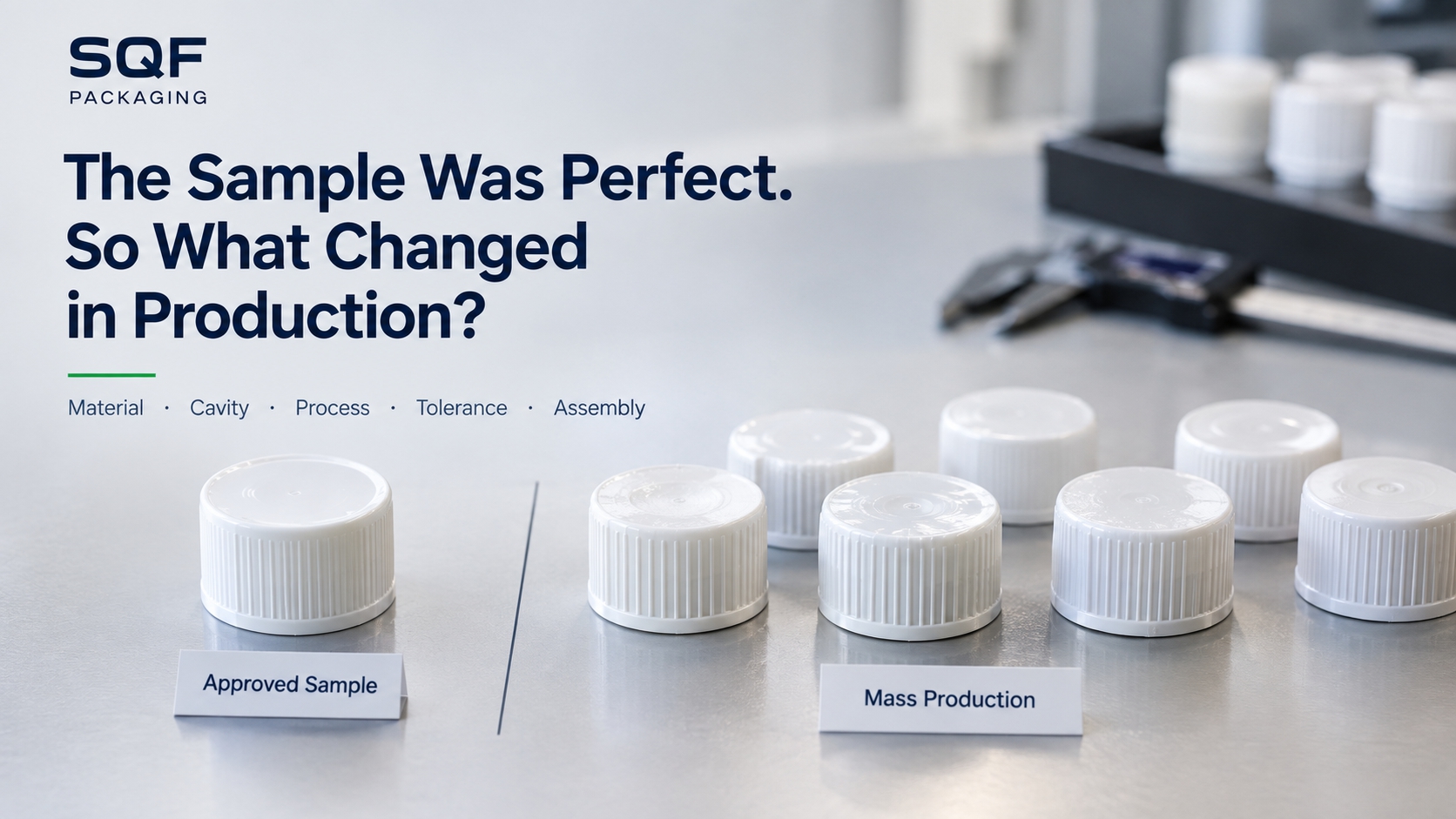
9. Control Changes Between Sample and Production
This is one of the areas buyers sometimes overlook.
The sample works.
The sample is approved.
Then production begins.
But what happens if the production closure uses a different liner?
Or a different resin?
Or the bottle comes from another production mold or supplier?
Changes that appear small can affect packaging performance.
For a CR packaging project, the approved specification should clearly identify critical components and requirements.
The objective is simple:
The package approved during development should be the package reproduced during production.
10. Look Beyond the Unit Price
When comparing CR closure quotations, the lowest unit price does not necessarily represent the lowest overall project cost.
Consider:
Tooling — Is a new mold really necessary?
MOQ — Does the quantity fit the launch plan?
Sampling — Can production-representative samples be supplied?
Liner — Is the quoted liner actually appropriate?
Testing — What validation is required?
Lead time — How quickly can samples and production be completed?
Quality control — How will the approved configuration be maintained?
Logistics — How will closures be packed and shipped?
A fraction of a cent saved on the closure itself can become irrelevant if the package later experiences leakage, fit problems or production delays.
11. What Should You Send with a CR Closure RFQ?
A good RFQ does not need to be complicated.
For most projects, start with:
Bottle drawing or neck-finish drawing
Bottle material
Physical bottle samples, if available
Product/application
Required closure color
Liner or sealing requirement, if known
Initial order quantity
Estimated annual volume
Target market
Any required testing or compliance expectations
If some of these details are unknown, that is not necessarily a problem.
A good sourcing process should help identify what still needs to be determined.
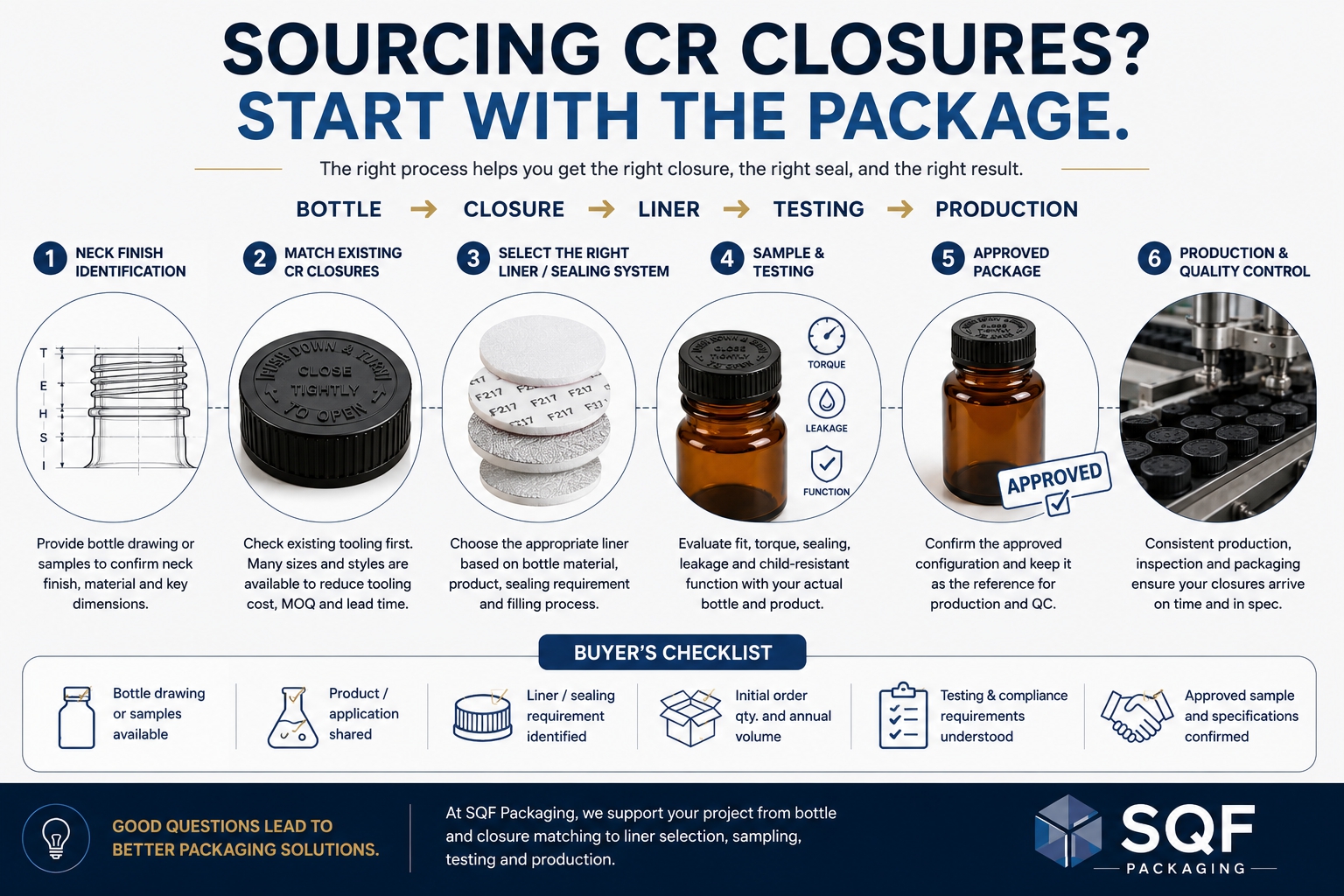
From RFQ to Production: A Practical CR Closure Sourcing Process
At SQF Packaging, we prefer to approach a child-resistant closure project in this sequence:
1. Review the bottle drawing or sample
↓
2. Search existing CR closure platforms
↓
3. Match the neck finish
↓
4. Evaluate liner and sealing options
↓
5. Provide samples
↓
6. Test fit, sealing and package performance
↓
7. Confirm the approved configuration
↓
8. Move into production and quality control
Custom tooling can then be introduced when the project actually requires it — rather than automatically becoming the starting point.
One Final Checklist Before You Place the PO
Before releasing a CR closure order, can you answer these questions?
Is the exact bottle neck finish confirmed?
Has the closure been physically tested on the intended bottle?
Is the liner specification defined?
Has product compatibility been considered?
Are application and removal requirements understood?
Is the approved sample or specification documented?
Are relevant CR testing or compliance requirements understood?
Are production tolerances and quality expectations defined?
If the answer to one of these is “not yet,” it may be worth resolving it before production begins.
Better Sourcing Starts with Better Questions
The most useful question in CR closure sourcing is rarely:
“What is your price for a 28mm CR cap?”
A better question is:
“What existing child-resistant closure can work with this bottle, product and packaging requirement?”
That changes the conversation from buying a cap to developing a packaging system.
At SQF Packaging, we support child-resistant closure projects from existing-tooling evaluation and bottle/closure matching through liner selection, sampling, validation and production execution in Asia.
If you have a new CR packaging project, a bottle drawing or physical sample is usually the best place to start.
FAQ: Sourcing Child-Resistant Caps
What information do I need to get a CR cap quote?
Ideally provide the bottle or neck-finish drawing, bottle material, product application, required color, liner requirement, initial order quantity and estimated annual volume.
Can I source a CR cap without a bottle drawing?
Yes. If a reliable technical drawing is unavailable, physical production bottles can be evaluated against existing CR closure options.
Should I develop a custom mold for a CR cap?
Not necessarily. Existing CR closure tooling should generally be evaluated first. Custom tooling becomes more relevant when existing options cannot meet the required fit, functionality, appearance or branding.
What is the MOQ for child-resistant caps?
There is no universal MOQ. It depends on the closure, color, liner, customization and manufacturing process. Existing tooling generally provides more flexibility than a completely custom closure.
Should I send my bottle to the CR cap supplier?
For many projects, yes. Physical bottle samples can be valuable for confirming fit and conducting package-level evaluation, especially when the bottle and closure come from different manufacturers.
What should I test before ordering CR caps?
Depending on the application, evaluation may include fit, thread engagement, application and removal torque, liner performance, leakage, sealing and product compatibility. Applicable child-resistant testing requirements should also be determined where formal compliance is required.