Why Viscosity Matters When Choosing an Airless or Lotion Pump
Dosage and formula type are useful starting points. Understanding how a formula flows helps turn those requirements into reliable dispensing.
At SQF Packaging, customers often begin a pump inquiry with two questions: “What is the output per stroke?” and “Is this pump suitable for an oil-based formula?”
Both questions matter. However, another detail deserves attention early in the conversation: the viscosity of the formula.
Viscosity influences how readily a product enters the pump chamber and moves through the dispensing path. It can affect priming, dispensing consistency, and the time the pump needs to refill between strokes. A pump with the right nominal output still needs to be tested with the formula it will dispense.
Oil Content and Viscosity Tell Us Different Things
An oil-based formula is not necessarily thick, and a water-based formula is not necessarily thin. A lightweight facial oil may flow readily, while a water-based gel may resist movement until pressure is applied.
Formula composition helps identify material compatibility requirements. Viscosity describes resistance to flow under specified conditions. Both are relevant to pump selection.
Many lotions, creams, and gels also change their apparent viscosity when stirred, squeezed, or pumped. This means the texture observed in a jar does not fully describe how the product will behave inside a dispensing system.
How Viscosity Affects a Lotion Pump
A conventional lotion pump typically draws product through a dip tube. After each stroke, the pump chamber must refill before it can deliver another full dose.
When a formula is too resistant to flow for a particular pump configuration, users may experience:
- More strokes before product first appears.
- Slower chamber refill between presses.
- Reduced or inconsistent output during repeated use.
- Greater difficulty dispensing the remaining product near the bottom of the bottle.
These outcomes depend on the complete design, including the dip tube, inlet, valves, pump chamber, and outlet.
Lower-viscosity formulas also need testing. Valve and seal performance, leakage resistance, and clean cutoff at the nozzle remain important even when the product flows easily.
How Viscosity Affects an Airless Pump
Airless packaging commonly uses a moving piston or collapsing inner container to compensate as product is dispensed. This reduces air contact with the bulk formula and can help improve product evacuation.
Some airless systems are designed for highly viscous formulas. However, “airless” is not a universal viscosity rating. Different designs have different capabilities, and the formula must still pass through the pump’s inlet, valves, and outlet. Manufacturer portfolios include distinct systems for different formulation needs. Reference: Aptar airless packaging
The bottle and pump should therefore be evaluated together. A formula that dispenses successfully through one airless package may behave differently in another.
What Does a Viscosity Reading Tell Us?
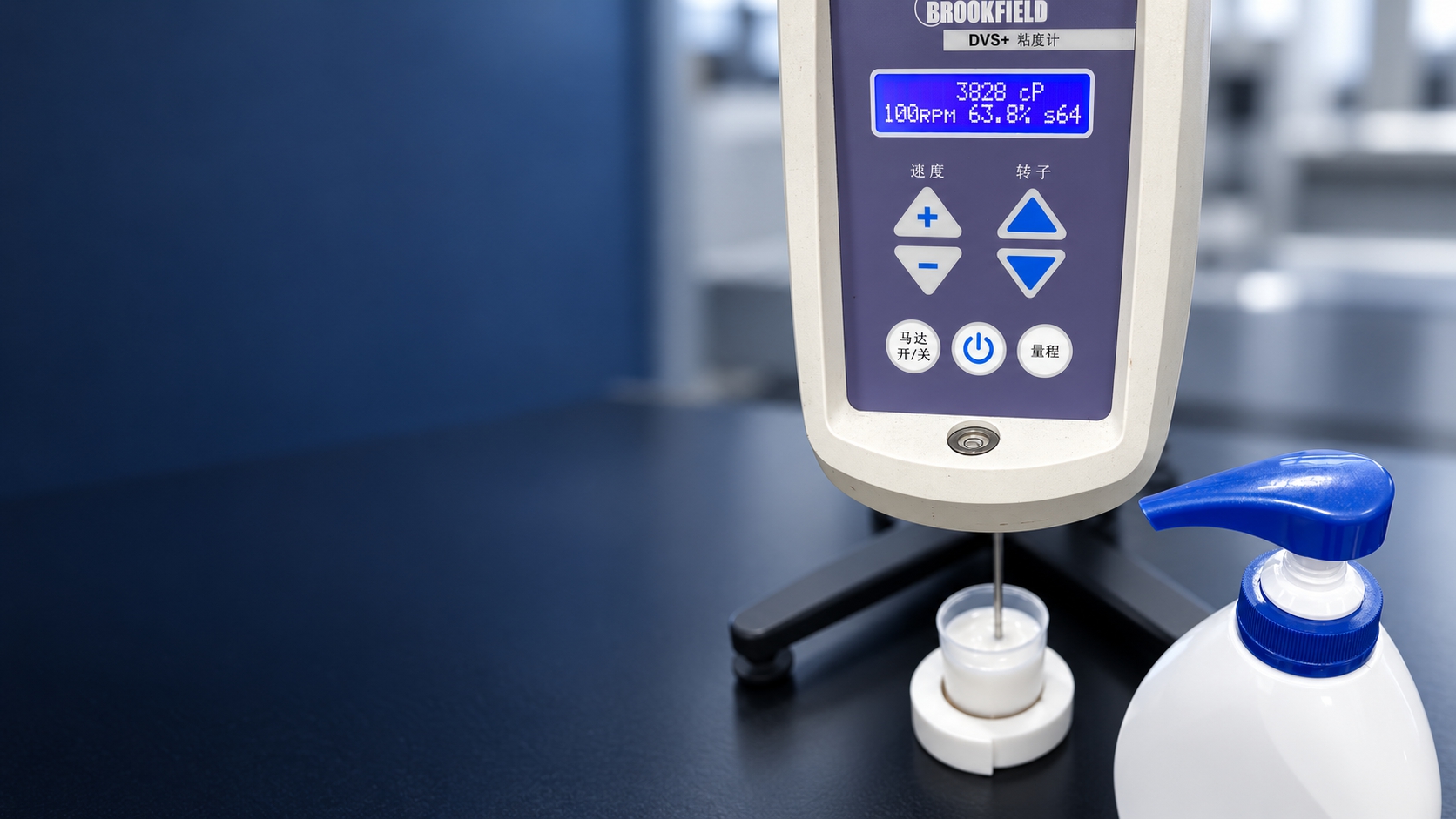
The accompanying photograph shows a viscosity reading of 3,828 cP at 100 rpm. The unit cP, or centipoise, is numerically equivalent to mPa·s.
That reading is useful, but it needs context. For meaningful comparisons, viscosity data should include the measurement temperature, instrument and spindle, rotational speed, and test procedure. These conditions are important to consistent measurements, particularly for formulas whose viscosity changes under different test conditions. Reference: Brookfield measurement guidance
The photograph alone does not establish the measurement temperature or provide a complete test record. It also does not show that a particular pump is suitable for every formula with the same viscosity reading.
Two formulas with similar measured viscosity can behave differently during dispensing because their flow behavior, elasticity, or response to shear differs.
What Should You Share When Requesting a Pump?
To help SQF Packaging understand your application, include the following information in your inquiry:
| Information | Why it helps |
|---|---|
| Product type and formula base | Guides initial pump selection and material compatibility review. |
| Target output per stroke | Defines the required dispensing amount; specify mL or g. |
| Viscosity and test conditions | Gives a clearer description of formula flow. |
| Bottle size, neck finish, and packaging format | Helps identify a compatible complete package. |
| Expected storage and use temperatures | Helps define relevant dispensing test conditions. |
| A representative formula sample | Allows the proposed package to be tested with the actual product. |
If viscosity data is unavailable, start with a sample and a clear description of the product. A pouring or dispensing video can help with initial discussion, while physical testing provides stronger evidence for final selection.
From Pump Specifications to Product Performance
A viscosity measurement helps narrow the options. Testing confirms how the formula and package work together.
Evaluation should cover initial priming, output per stroke, repeated dispensing, refill behavior, leakage, nozzle cutoff, and product evacuation. Testing after storage and at relevant temperatures can reveal changes that a first-use check may miss.
Considering viscosity early helps make pump selection more informed and gives the development team a clearer basis for evaluating samples.
Planning your next packaging project? Share your formula details, target dosage, and available viscosity data with SQF Packaging to start the pump selection discussion.