Does a Child-Resistant Cap Mean the Package Is Child-Resistant?
A supplier offers you a child-resistant cap.
Does that mean the finished bottle is now a child-resistant package?
Not necessarily.
This is one of the most important distinctions to understand when sourcing child-resistant packaging.
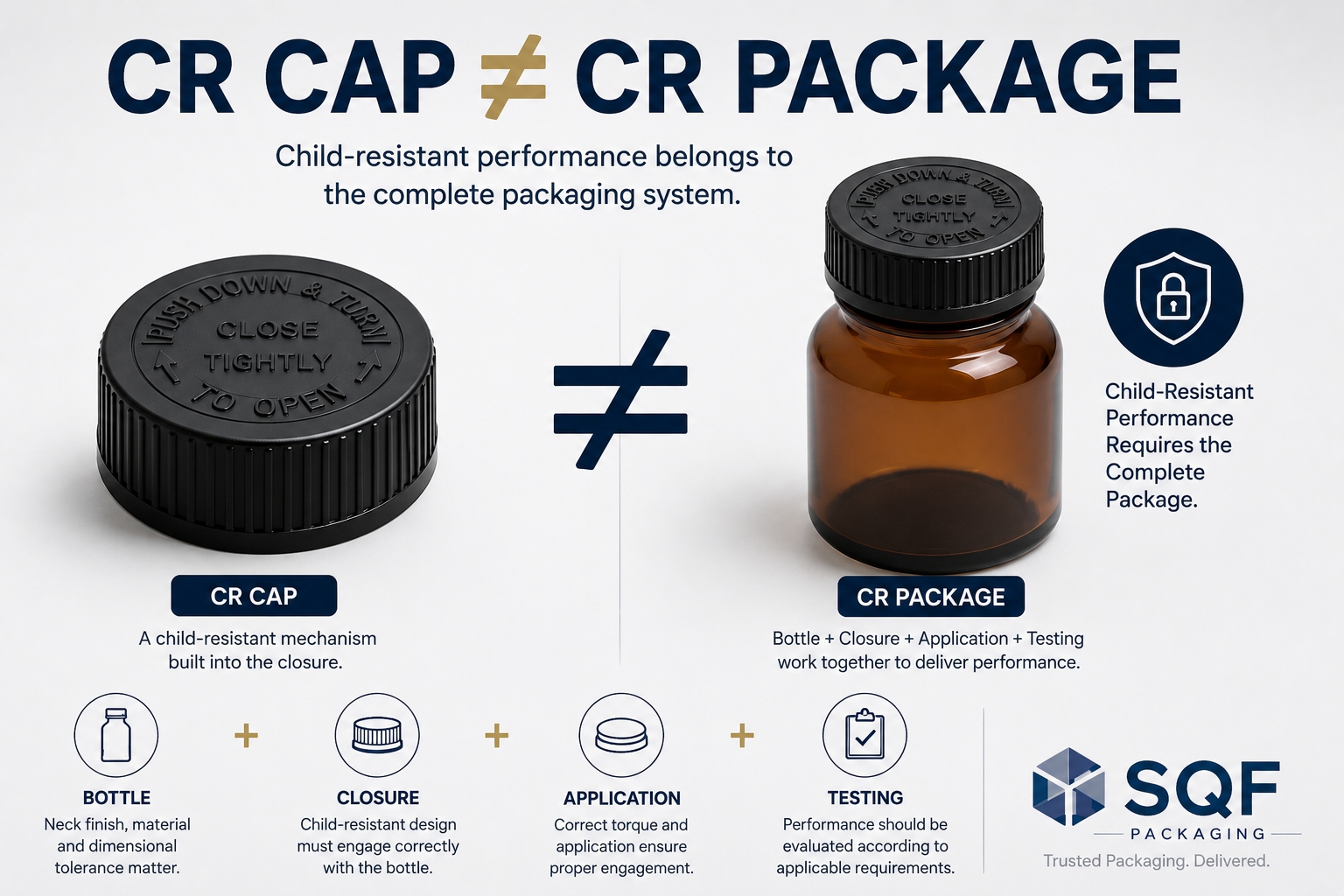
A closure may be designed with a child-resistant mechanism — such as the familiar push-down-and-turn system — but child-resistant performance is not determined by the cap alone.
The container and closure work as a system.
That difference matters when moving from sourcing a CR closure to developing a finished package.
What Is a Child-Resistant Cap?
A child-resistant cap, often called a CR cap, CR closure or CRC closure, is designed with an opening mechanism intended to make access more difficult for young children while remaining usable by adults.
A common example is the push-down-and-turn closure.
The user must perform two actions simultaneously:
push downward + turn the cap
The mechanism is built into the closure design, but its actual performance can depend on how that closure interacts with the bottle.
That is why the words “child-resistant cap” describe the closure — not necessarily the compliance status of every finished package using it.
Why the Bottle Matters
Imagine taking the same CR cap and putting it onto two different bottles.
The nominal neck diameter might be identical.
But the bottles could differ in:
- neck-finish dimensions
- thread profile
- thread engagement
- finish height
- sealing surface
- dimensional tolerances
Those differences can affect how far the closure travels onto the bottle and how the child-resistant mechanism engages.
In other words:
A proven CR closure does not automatically make every compatible-looking bottle a proven CR package.
This is another reason why matching a CR closure by diameter alone is not enough.
Child-Resistant Performance Belongs to the Package System
For sourcing purposes, it helps to think about child-resistant packaging as a system:
Bottle + CR Closure + Correct Application = Finished Package
The cap provides the child-resistant mechanism.
The bottle provides the neck finish with which that mechanism interacts.
The application process determines how the closure is installed.
All three can affect the finished package.
Fit Is Not the Same as CR Performance
One of the easiest mistakes during development is to test whether the cap screws onto the bottle and conclude:
“It fits, so we're good.”
Mechanical fit is important, but it answers only one question.
A proper package evaluation may also need to consider:
Does the closure engage correctly?
Is the application torque appropriate?
Can the cap be removed and reapplied correctly?
Does the package maintain its sealing performance?
Does the CR mechanism continue to function consistently?
A cap can physically fit a neck without answering all of these questions.
What About the Liner?
The liner adds another variable.
A change in liner thickness or construction can affect how a closure sits on the bottle and how the package seals.
Depending on the application, CR closures may use:
- PE foam liners
- F217-type liners
- pressure-sensitive liners
- induction-seal liners
- other application-specific sealing systems
The liner therefore needs to be evaluated as part of the package configuration.
This is why changing from one liner to another should not automatically be treated as an insignificant change.
What Should Be Tested?
The exact testing program depends on the product, market and applicable requirements.
From a packaging-development perspective, evaluation may include areas such as:
Fit and engagement
Does the closure properly engage with the intended bottle finish?
Application and removal torque
Can the closure be applied consistently and subsequently opened as intended?
Sealing and leakage
Does the selected bottle, closure and liner combination provide the required seal?
Product compatibility
Are the closure and liner suitable for the intended contents?
Child-resistant performance
Where formal CR compliance is required, the complete package should be evaluated according to the applicable requirements for the intended market and product category.
The key point is that these are package-level questions, not simply cap-level questions.
What Does a Supplier's CR Certificate Actually Cover?
This is an important question to ask.
If a closure supplier provides documentation relating to child-resistant performance, buyers should understand what exact package configuration was evaluated.
For example:
- Which closure?
- Which container?
- Which neck finish?
- Which liner or sealing system?
- What package configuration?
- Which test method or standard?
- Is your proposed package the same configuration?
A document associated with a CR closure should not automatically be assumed to cover every bottle onto which that closure might fit.
When compliance matters, the scope of the documentation matters too.
Can I Use a Different Bottle with the Same CR Cap?
Possibly — but it should not be assumed solely because the closure fits.
If the bottle changes, the interaction between bottle and closure may also change.
This becomes particularly important when moving between bottle suppliers.
Two bottles may both be sold under what appears to be the same nominal neck specification while still having manufacturing or dimensional differences that deserve evaluation.
For packaging projects requiring formal CR performance, the impact of changing components should be reviewed before treating the new combination as equivalent.
What About Custom CR Caps?
The same principle applies when developing a custom child-resistant closure.
Creating a push-down-and-turn mechanism is only part of the project.
The closure needs to be developed around the intended bottle finish and then evaluated as part of the complete package.
This is one reason why, at SQF Packaging, we generally prefer to begin by reviewing existing CR closure platforms.
If a suitable existing closure can be matched to the intended bottle, it may reduce:
tooling cost, development time, initial MOQ and technical risk.
If existing tooling cannot meet the requirement, custom development can then be evaluated with the bottle specification already defined.
A Better Question to Ask Your CR Closure Supplier
Instead of asking:
“Is this cap child-resistant?”
consider asking:
“What bottle-and-closure configuration has this CR cap been evaluated with, and what do we need to verify for our bottle?”
That question provides much more useful information.
It shifts the discussion from buying an individual component to developing a functional packaging system.
CR Packaging Should Be Treated as a System
A child-resistant closure is an important component.
But it is still a component.
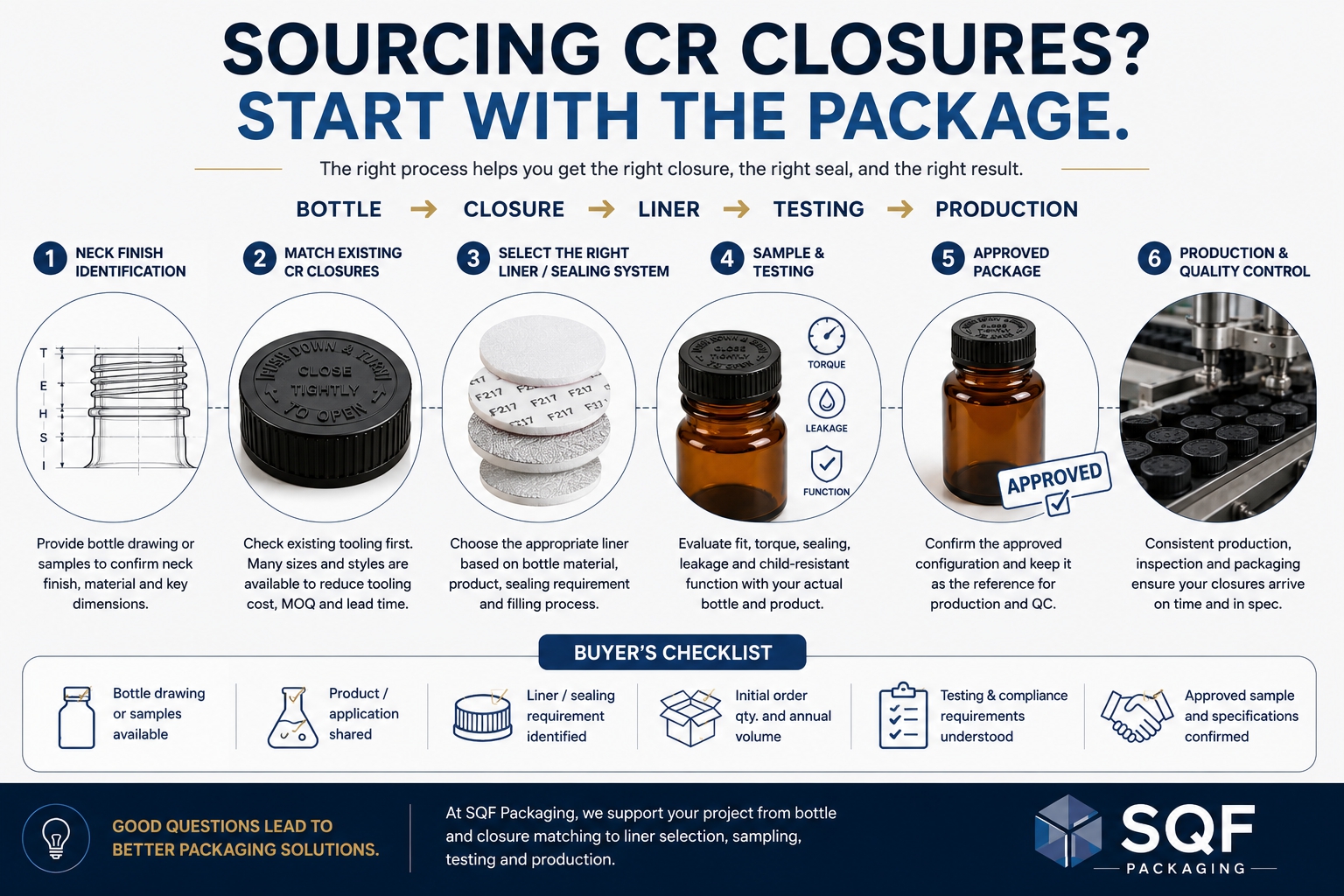
For a new CR packaging project, a practical development sequence is:
1. Confirm the bottle and neck finish
2. Identify a compatible CR closure
3. Select the appropriate liner or sealing system
4. Evaluate physical samples
5. Check fit, torque and sealing performance
6. Determine applicable child-resistant testing requirements
7. Approve the final package configuration before production
At SQF Packaging, we support CR closure sourcing and development across a range of sizes and configurations, with the objective of matching the bottle, closure and sealing system before moving into production.
Because the real question is not simply:
“Is this a CR cap?”
It is:
“Will this bottle-and-closure system perform as required?”
FAQ: Child-Resistant Caps and Package Compliance
Does a CR cap automatically make a bottle child-resistant?
No. A CR cap incorporates a child-resistant mechanism, but the performance of the finished package depends on the complete bottle-and-closure system and its application.
Can a certified CR cap be used on any bottle with the same neck size?
Not automatically. Nominal size alone does not establish that another bottle-and-closure combination has the same performance or is covered by the same testing or documentation.
Does the bottle affect child-resistant performance?
Yes. Neck-finish dimensions, threads, closure engagement and other aspects of the bottle-and-closure interface can affect how the finished package functions.
Does changing the liner matter?
Potentially. Different liner constructions and thicknesses can affect sealing and the final closure position, so changes should be evaluated within the complete package.
What should I ask for when a supplier says a closure is CR tested?
Ask what specific closure, bottle, neck finish and package configuration were evaluated, which test method or standard was used, and whether the documentation applies to your proposed package.
Should the complete package be tested?
Where formal child-resistant compliance is required, the applicable testing and regulatory requirements should be determined for the complete package and intended market.