How to Choose the Right Liner for a Plastic Bottle Closure
Choosing a closure is only part of building a reliable package. The liner inside the cap can be just as important as the cap itself.
Different liners are designed for different bottle materials, products, sealing requirements and filling conditions. A liner that works well on one package may perform poorly on another, even when the closure size and neck finish are the same.
Start with the bottle material
The first question is usually not “Which liner is better?”
It is:
What material is the bottle made from?
PET, HDPE, PP and glass have different sealing surfaces and respond differently to compression, heat and induction sealing.
For example, an induction seal liner designed for PET may use a different sealing layer from one intended for PE containers.
The liner should therefore be selected together with the bottle material rather than treated as a universal component.
Foam liners: simple, but not universal
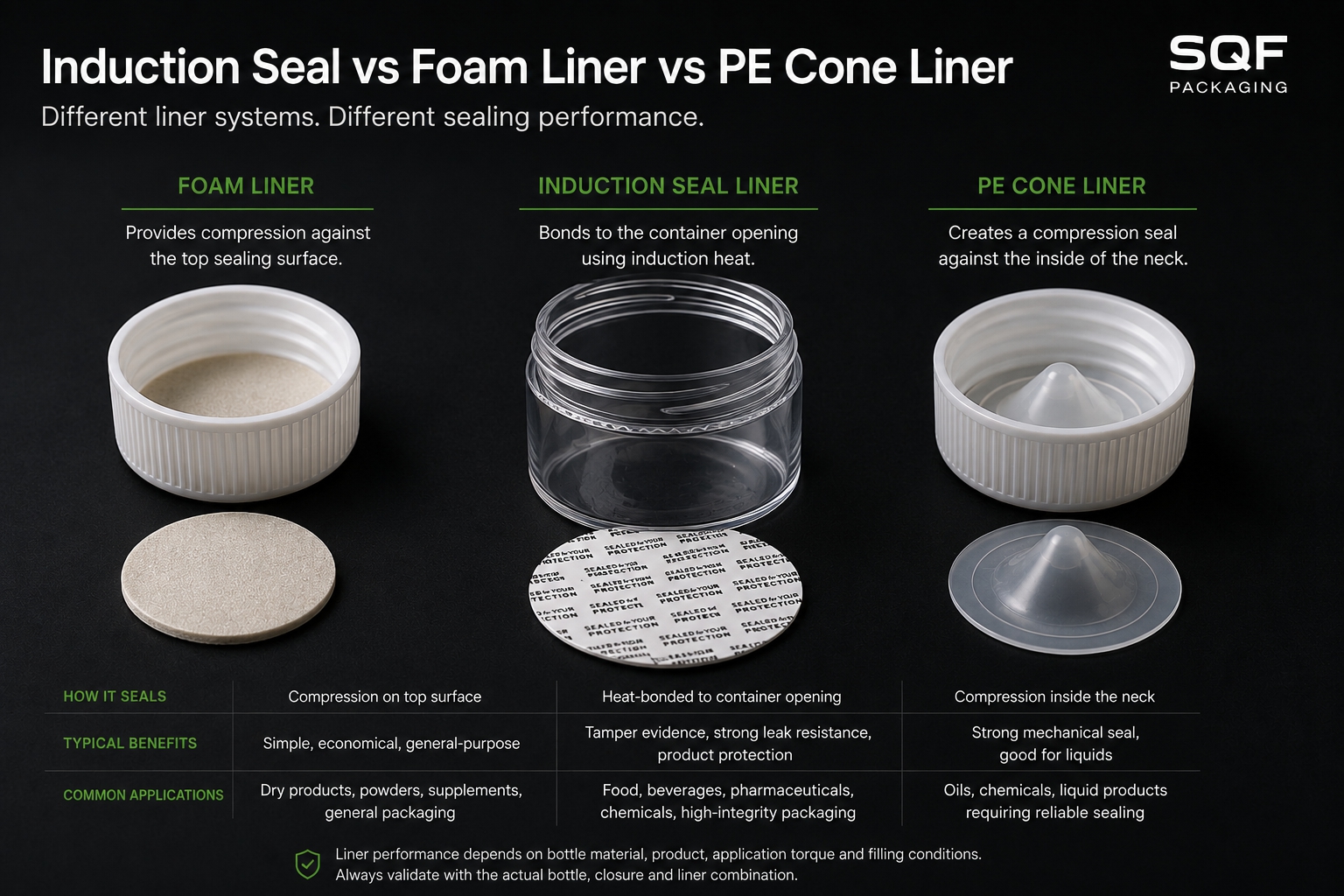
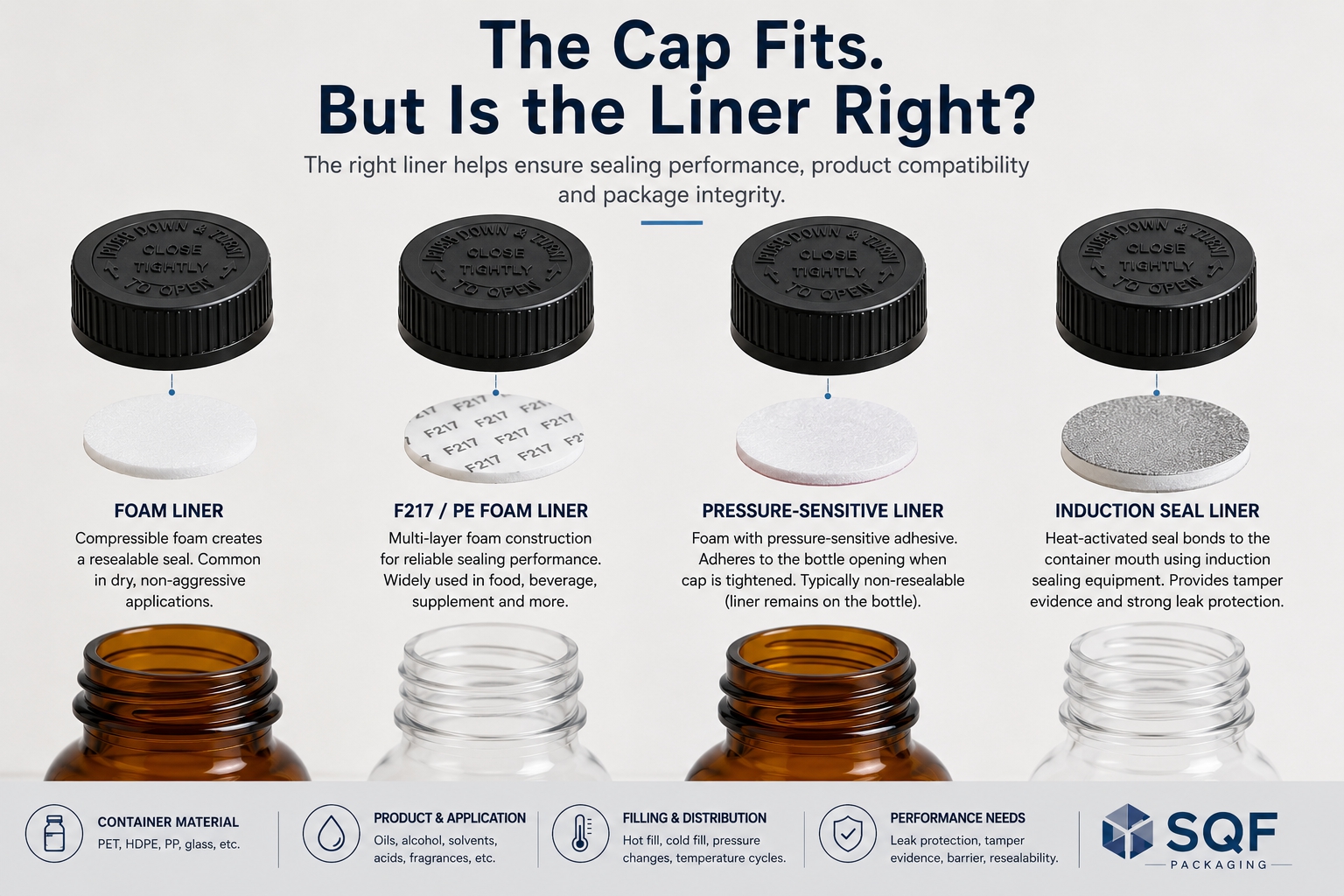
Foam liners are widely used because they are economical and provide compression between the closure and bottle sealing surface.
They can work well for many dry products and applications where a basic seal is sufficient.
However, foam liners do not automatically provide a hermetic or tamper-evident seal.
Their performance depends on:
-
liner material and thickness
-
bottle sealing surface
-
closure design
-
application torque
-
product compatibility
For liquid products, especially those with demanding leakage requirements, additional testing is usually necessary.
Induction seal liners: when stronger sealing is required
An induction heat seal liner bonds a foil-based sealing layer to the bottle opening after the cap has been applied.
This can provide:
-
tamper evidence
-
improved leak resistance
-
protection from contamination
-
better product integrity during transport
But the sealing layer must match the bottle material.
A liner designed for PET is not necessarily suitable for HDPE, PP or glass.
Induction sealing also depends on the equipment settings, line speed, sealing head position and application torque.
Even the correct liner can fail if the sealing process is not properly controlled.
PE cone liners: useful where compression and chemical resistance matter
Cone-shaped PE liners create a mechanical seal by pressing against the inside surface of the bottle neck.
They are commonly used in applications where a conventional flat liner may not provide enough sealing pressure.
Because the liner forms a compression seal inside the neck, compatibility with the bottle finish is critical.
Small differences in the neck inside diameter or geometry can significantly affect performance.
The sealing surface matters
Even when the liner material is correct, the package can still leak if the bottle sealing surface is uneven, damaged or outside specification.
Common issues include:
-
uneven bottle finish
-
flash or molding defects
-
dimensional variation
-
insufficient liner compression
-
inconsistent closure application torque
This is why liner selection should not be separated from bottle and closure validation.
Product compatibility also matters
The product inside the package can influence liner selection.
Oil-based products, alcohol-containing formulas, solvents, fragrances and aggressive chemicals may interact differently with liner materials.
For sensitive applications, chemical compatibility should be confirmed before production.
A liner should not be selected based only on cost or appearance.
There is rarely a truly “universal” liner
The word “universal” is sometimes used commercially, but it should be treated carefully.
A liner may work across several bottle materials or product categories, but that does not mean it will perform identically in every package.
A better approach is to evaluate the complete system:
Bottle + Closure + Liner + Product + Application Process
Validate before production
Before approving a liner for production, we normally recommend checking at least:
-
closure and bottle fit
-
liner contact with the sealing surface
-
application torque
-
leak resistance
-
induction seal performance, if applicable
-
product compatibility
-
stability after storage or transportation simulation
A liner that looks correct inside the cap is not necessarily the right liner for the package.
The best liner is not the one that fits the closure. It is the one that performs reliably with the complete packaging system.
FAQ
Can the same liner be used for PET and HDPE bottles?
Sometimes, but not always. The sealing layer and liner construction should be confirmed for the specific bottle material.
Is a foam liner suitable for liquids?
It may be suitable for some applications, but leakage performance should be tested with the actual bottle, closure and product.
What is the main advantage of an induction seal liner?
It can provide tamper evidence and stronger sealing performance by bonding directly to the bottle opening.
Why does an induction liner sometimes fail to seal?
Possible causes include incorrect liner material, insufficient or excessive torque, poor bottle sealing surfaces, incorrect induction settings or inconsistent container dimensions.
Should liner selection be done before sampling?
Ideally, yes. The intended liner should be included during sample validation so the bottle, closure and liner can be evaluated as one system.