Induction Seal vs Foam Liner vs PE Cone Liner: What’s the Difference?
Choosing a closure liner is not simply a matter of finding one that fits inside the cap.
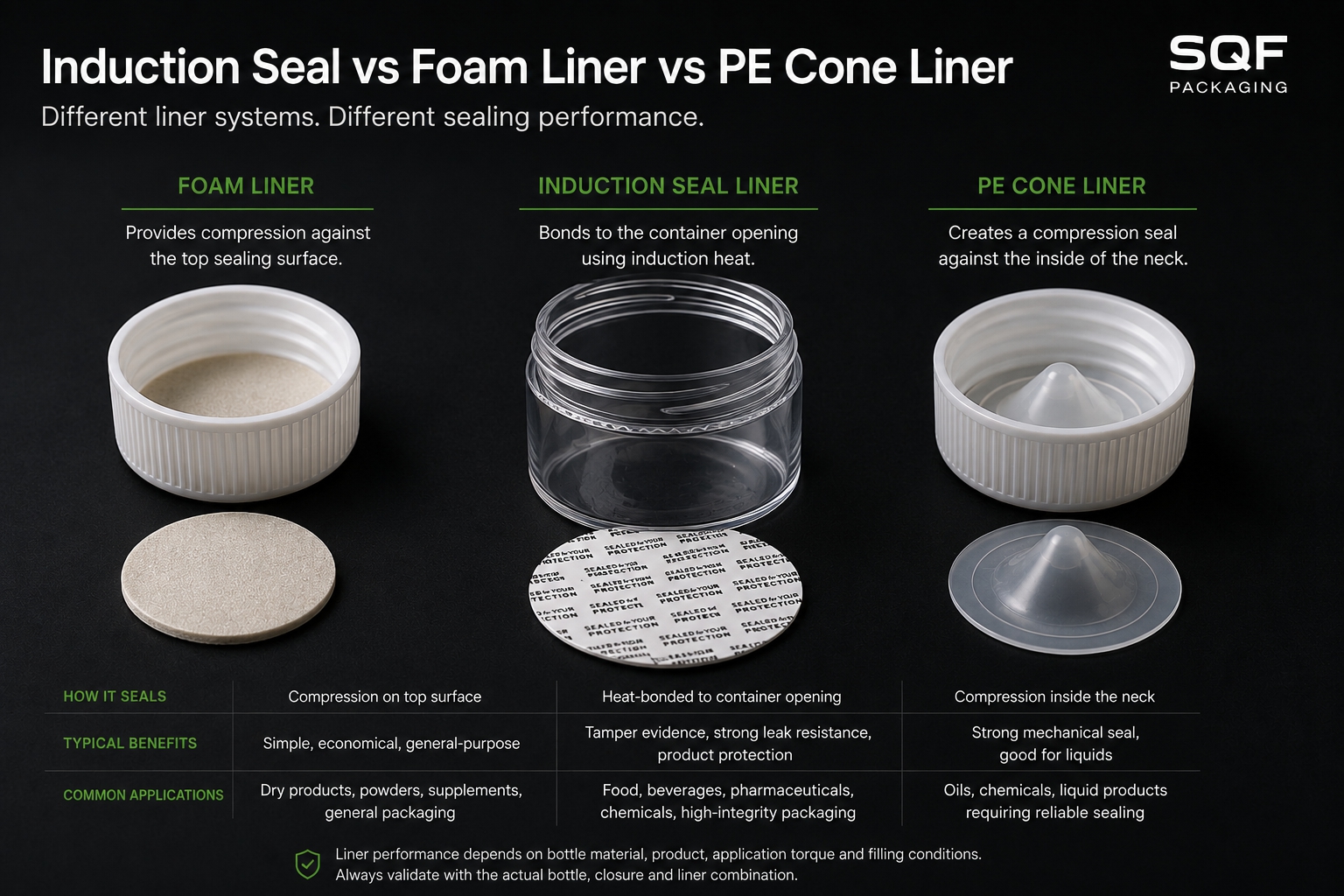
Different liner systems create a seal in different ways. An induction seal bonds to the container opening, a foam liner relies primarily on compression, while a PE cone liner seals against the inside of the bottle neck.
Understanding these differences is important when selecting a closure for a new packaging application.
1. Foam Liners
Foam liners are flat, compressible liners placed inside the closure.
When the closure is tightened, the liner compresses against the top sealing surface of the bottle or jar.
Where they work well
Foam liners are commonly used for:
- dry products
- powders and tablets
- general-purpose packaging
- applications that do not require a foil seal
They are relatively simple and economical.
However, a foam liner should not automatically be considered leak-proof. Performance depends on the bottle finish, liner compression, application torque and the product being packaged.
For demanding liquid applications, testing the complete package is important.
2. Induction Seal Liners
Induction liners typically contain an aluminum foil sealing layer that is bonded to the container opening using an induction sealing process.
Unlike a foam liner, the final seal is attached directly to the container.
Why use an induction seal?
Depending on the liner construction and application, induction sealing can provide:
- improved leak resistance
- tamper evidence
- contamination protection
- reduced product loss during transportation
- improved shelf integrity
But there is an important detail:
The heat-seal layer must be compatible with the container material.
A liner designed to seal to PET may not be suitable for HDPE or PP.
The correct liner can also fail if application torque, induction power, line speed or sealing-head setup is incorrect.
3. PE Cone Liners
A PE cone liner works differently from both foam and induction liners.
Instead of sealing primarily against the top surface of the bottle finish, the cone-shaped liner enters the bottle opening and creates a compression seal against the inside of the neck.
This makes it useful for certain liquid and chemical applications where a strong mechanical seal is required.
What needs to be checked?
The inside dimensions and geometry of the bottle neck become particularly important.
If the opening is too large, too small, irregular or inconsistent, the cone may not create the intended compression.
For this reason, simply knowing the nominal neck finish is not always enough when evaluating a cone-lined closure.
The Three Systems Are Not Interchangeable
Here is the simplest way to think about them:
| Liner Type | How It Seals | Typical Reason for Use |
|---|---|---|
| Foam liner | Compression against the top sealing surface | Simple, economical general-purpose seal |
| Induction seal liner | Foil layer bonds to the container opening | Tamper evidence and stronger product protection |
| PE cone liner | Compression against the inside of the bottle neck | Mechanical sealing for certain liquid applications |
There is no liner that is automatically “best.”
The right choice depends on the package.
Start With the Application, Not the Liner
When evaluating a liner, we prefer to start with a few basic questions:
What is the bottle material?
PET, HDPE, PP and glass can require different sealing solutions.
What is being filled?
A dry supplement, oil, water-based product and chemical product can have very different requirements.
Does the package require tamper evidence?
If so, an induction seal may be appropriate.
How demanding is the leakage requirement?
Shipping orientation, temperature changes and distribution conditions should be considered.
What does the bottle finish actually look like?
The top sealing surface and internal neck geometry can determine whether a particular liner system will work.
These questions are more useful than simply asking:
“Which liner is better?”
A Liner Is Part of a Packaging System
A common packaging mistake is evaluating the closure, liner and bottle independently.
In practice, sealing performance comes from the interaction between:
Bottle + Closure + Liner + Product + Application Process
Changing only one of these variables can change the performance of the entire package.
This is particularly important when switching suppliers, changing bottle materials or replacing an existing closure with a supposedly equivalent alternative.
Validate With Actual Components
Specifications can help narrow down the correct liner, but final approval should be based on the actual packaging combination.
Depending on the application, validation may include:
- fit and thread engagement
- application and removal torque
- liner compression
- leak testing
- induction sealing trials
- product compatibility
- storage and transportation testing
A closure that looks correct on a drawing can still perform differently when assembled with the actual bottle and liner.
The right liner is not determined by the closure alone. It is determined by how the complete package needs to perform.
FAQ
Is an induction seal better than a foam liner?
Not necessarily. Induction liners provide benefits such as tamper evidence and a bonded seal, while foam liners can be appropriate for simpler applications. The correct choice depends on the product and packaging requirements.
Can foam liners prevent leakage?
They can provide effective sealing in suitable applications, but they should not automatically be assumed to be leak-proof. Actual package testing is recommended for liquids.
What is a PE cone liner used for?
A PE cone liner creates a compression seal against the inside of the bottle neck and is commonly considered for applications requiring a mechanical seal.
Can the same induction liner be used for PET and HDPE?
Not necessarily. The heat-seal layer needs to be compatible with the container material.
How do I know which liner my bottle needs?
Start with the bottle material, neck finish, product being filled, sealing requirement and filling process. Then test the proposed bottle, closure and liner together before production.