Bakelite Caps vs. Bakelite-Look PP: Why the Material Matters
When a packaging specification calls for a “Bakelite cap,” it may sound straightforward.
In practice, particularly when sourcing packaging closures from China and other parts of Asia, the term Bakelite can sometimes describe an appearance or style rather than the actual material.
That distinction matters.
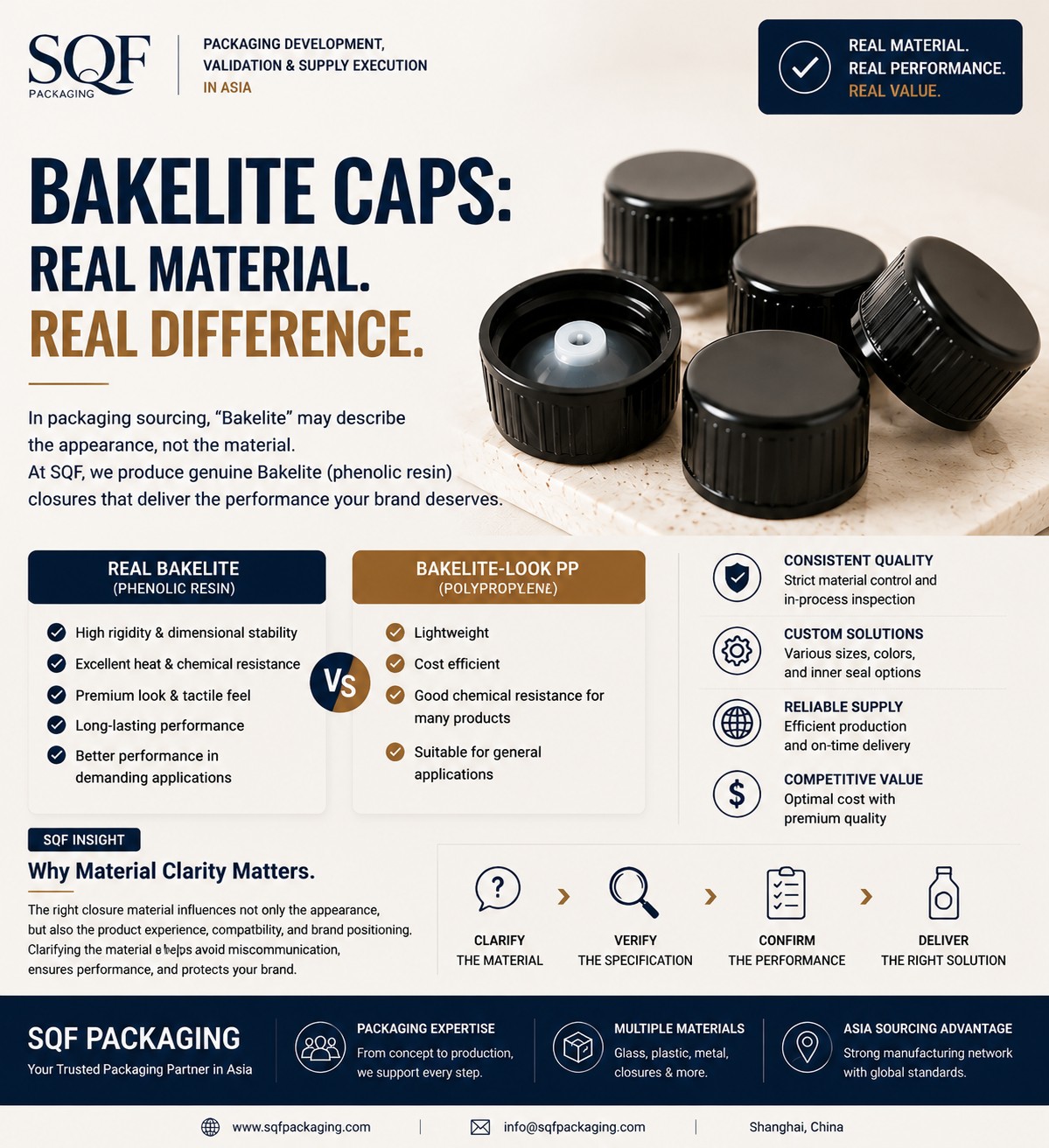
A genuine Bakelite closure is made from phenolic resin, while many closures marketed as “Bakelite-look,” “Bakelite-style,” or similar descriptions are actually manufactured from polypropylene (PP).
They can look remarkably similar, but they are not the same material and should not automatically be considered interchangeable.
What Is a Real Bakelite Cap?
Bakelite is commonly used to describe thermoset phenolic resin materials.
Unlike PP, which is a thermoplastic, phenolic resin forms a highly cross-linked structure during molding. Once cured, it does not simply soften and remelt like a conventional thermoplastic.
This gives phenolic closures several characteristic properties, including:
- high rigidity and dimensional stability
- good heat resistance
- a hard, substantial tactile feel
- good performance in many demanding applications
These characteristics are among the reasons phenolic resin closures continue to be used for selected premium spirits, fragrance, cosmetic, pharmaceutical and specialty packaging applications.
What Is a Bakelite-Look PP Cap?
A Bakelite-look closure is generally a polypropylene closure designed to reproduce the visual appearance of a traditional Bakelite cap.
This is not necessarily an inferior solution.
PP offers important advantages of its own, including lower weight, efficient high-volume molding, design flexibility and generally competitive manufacturing costs.
For many products, PP may actually be the more appropriate material.
The issue arises when a buyer specifies Bakelite believing that the closure is phenolic resin, while the quotation or sample being offered is actually PP.
That is why material identification should be confirmed during the specification and quotation stage.
Bakelite vs. PP: What Should Packaging Buyers Consider?
| Consideration | Phenolic Resin / Bakelite | Polypropylene (PP) |
|---|---|---|
| Material type | Thermoset | Thermoplastic |
| Rigidity | High | More flexible |
| Dimensional stability | Excellent | Application dependent |
| Heat resistance | Generally higher | Lower than typical phenolic systems |
| Weight / tactile feel | Heavier, harder feel | Lightweight |
| Manufacturing | Thermoset molding | Highly efficient injection molding |
| Cost | Typically higher | Generally more economical |
| Design flexibility | Application dependent | Very flexible |
| Typical positioning | Premium / specialty | Broad packaging applications |
There is therefore no universal answer to “Is Bakelite better than PP?”
The correct material depends on the product, closure design, filling conditions, required performance, annual volume, target cost and brand positioning.
Chemical Compatibility Is Especially Important
Material selection should never be based on appearance alone.
For products containing alcohol, fragrance oils, essential oils, solvents or other active ingredients, compatibility between the formulation and the complete closure system should be evaluated.
Importantly, compatibility is not determined by the outer cap material alone.
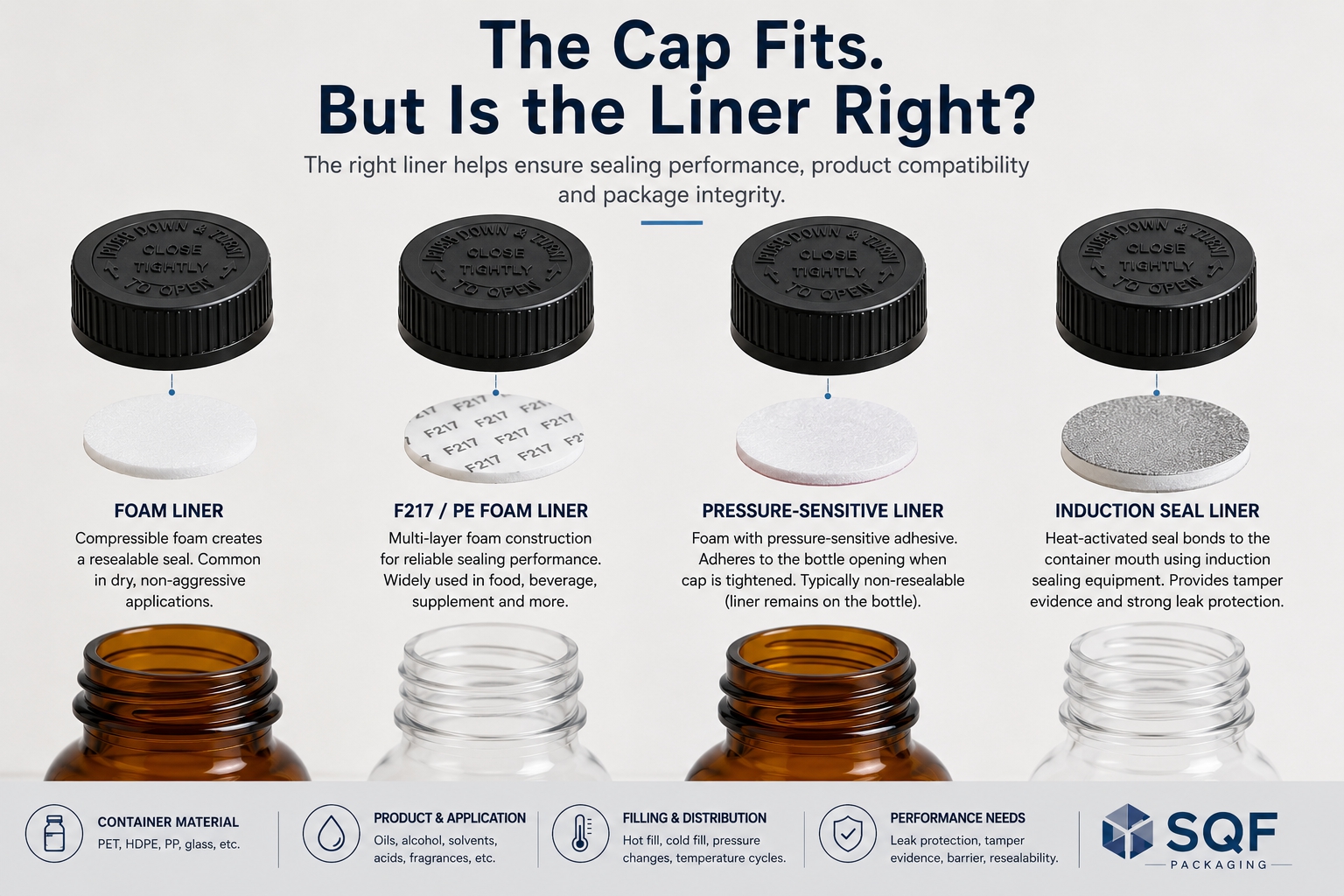
The liner, plug, sealing surface, closure geometry and actual product formulation can all influence long-term package performance.
For this reason, SQF Packaging recommends testing the actual closure with the actual formulation under representative storage and use conditions before commercial production.
Why “Bakelite” Can Be Confusing When Sourcing in China
This is particularly relevant when reviewing supplier quotations and product listings.
In the Chinese packaging supply chain, descriptions equivalent to “Bakelite-like,” “Bakelite feel,” or “Bakelite style” may be used commercially for products that reproduce the traditional appearance of Bakelite but are manufactured from PP or another plastic.
The description itself is not necessarily incorrect when clearly presented as a style.
The problem is specification ambiguity.
For buyers sourcing Bakelite caps from China, we recommend confirming at least:
- Actual resin/material specification
- Closure dimensions and neck finish
- Liner or sealing system
- Product/formula compatibility requirements
- Color and surface appearance
- Performance requirements
- Tooling requirements and MOQ
- Production and quality-control method
A photograph alone cannot confirm the material.
Sourcing Genuine Bakelite Caps from China
SQF Packaging supports the development and production of genuine Bakelite / phenolic resin closures in China, as well as PP and other closure solutions.
Our work can include material verification, closure development, tooling, sampling, liner selection, production execution and quality control.
Rather than beginning with the assumption that one material is always superior, we start with the application:
What is being packed?
How will the closure be used?
What performance is required?
What is the desired brand experience?
And what is the commercial target?
Only then should the material and manufacturing solution be finalized.
The Bottom Line
A Bakelite-looking cap is not necessarily a Bakelite cap.
Genuine Bakelite closures are made from phenolic resin. PP closures can reproduce a similar appearance while offering a different combination of weight, processing characteristics, performance and cost.
Neither material is automatically the right choice for every project.
The important part is knowing what material you are actually specifying and buying.
For projects requiring genuine phenolic resin closures, SQF Packaging can support Bakelite cap development, manufacturing and supply execution from China, including customized closure specifications and production requirements.