When Packaging Speaks Before Words: How Structural Design Builds Product Recognition
Structural packaging design can communicate before a consumer reads a label. A distinctive bottle shape, an unexpected closure detail, or a form associated with the product can attract attention, create an immediate association, and give a product a recognizable personality.
Labels, graphics and printing remain essential for explaining what a product is. But the physical package itself can influence what consumers notice and feel first.
This is where structural packaging design becomes more than a container. It becomes part of the product's communication.
What Is Structural Packaging Design?
Structural packaging design refers to the physical form and functional construction of packaging — including its shape, proportions, surface features, closure design, dispensing system and other three-dimensional elements.
It is different from graphic packaging design.
Graphic design communicates through elements such as:
-
labels
-
colors
-
typography
-
illustrations
-
printing and decoration
Structural design communicates through the package itself.
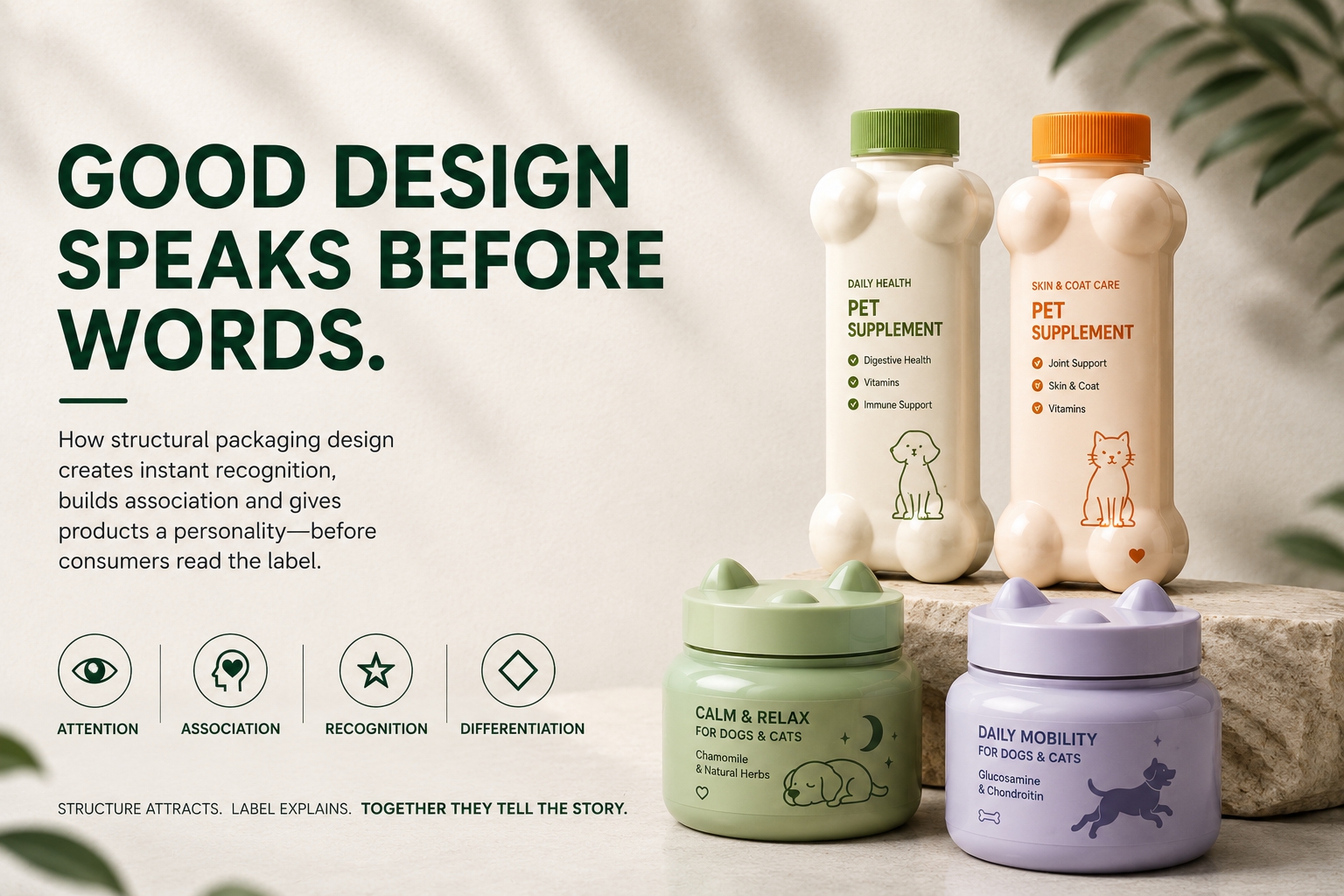
A bottle shaped around a familiar visual idea, for example, may create an association even when the label is removed. A closure incorporating a subtle character-inspired detail can add personality without changing the primary function of the package.
The two disciplines work best together:
Structure attracts. Label explains. Together, they tell the story.
Why Can Packaging Shape Matter?
Consumers rarely evaluate packaging one element at a time.
Shape, color, graphics, material and closure are perceived together, often within seconds.
This means the physical appearance of a bottle or jar can contribute to the first impression before detailed information is read.
Consider pet-related packaging as a simple example.
A bottle incorporating a bone-inspired form or a closure using small ear-like features does not necessarily tell consumers exactly what the product contains.
Nor does it replace the information on the label.
What it can do is create a visual association.
The consumer sees something familiar, playful or relevant to the product category. That association may encourage a closer look.
This is an important distinction.
Good structural packaging does not need to explain everything. Its job can simply be to make the product easier to notice, associate and remember.
Structural Design vs. Label Design: Which Communicates Faster?
There is no need to choose between them because they perform different jobs.
A label can communicate detailed information:
What is the product?
What are its benefits?
What ingredients does it contain?
How should it be used?
Who is the intended consumer?
Structural packaging works at another level.
It can communicate personality and create visual cues before those details are processed.
For example, changing a conventional closure into one with a carefully designed three-dimensional feature may create more immediate visual impact than adding another line of printed copy.
Similarly, changing the silhouette of a standard bottle can make the package recognizable from a greater distance.
The objective is not complexity.
The objective is meaningful differentiation.
Small Packaging Details Can Create Strong Associations
A successful structural idea does not always require a completely new bottle.
Sometimes the strongest design feature is relatively small.
It could be:
-
a distinctive shoulder profile
-
a recognizable bottle silhouette
-
an embossed element
-
a closure shape connected to the product concept
-
a tactile surface
-
an unusual but functional dispensing feature
These details can become visual shortcuts.
Instead of asking consumers to read more, the packaging gives them something they can recognize immediately.
That can be particularly valuable in categories where many products use similar containers and compete for attention with labels alone.
But Creative Packaging Still Has to Be Manufacturable
This is where an attractive concept becomes a real packaging-development project.
A design may look excellent in a rendering but still create problems during tooling, molding, filling, assembly or transportation.
Before developing custom structural packaging, several practical questions should be considered.
Can the design be molded reliably?
Complex curves, deep recesses, undercuts or unusual geometry can affect mold design and part release.
Will the package perform consistently in mass production?
A prototype can look perfect while production from multiple cavities introduces dimensional variation.
Does the closure still function correctly?
Decorative features cannot compromise sealing, opening torque, thread engagement or liner performance.
Can existing filling and capping equipment handle it?
A visually distinctive container has limited commercial value if it creates instability or orientation problems on an automated filling line.
What does the design do to cost?
Additional material, complex tooling, secondary operations and slower cycle times can quickly turn a clever idea into an expensive package.
Can it survive transportation?
Structural features must also be evaluated for packing efficiency, compression, drop performance and container loading.
For this reason, good packaging development requires both design thinking and manufacturing thinking.
The Best Packaging Ideas Are Often Simple
Custom packaging does not have to mean complicated packaging.
In fact, some of the most effective concepts begin with a very simple question:
Is there one physical detail that could connect the package more naturally with the product?
If the answer is yes, that detail may be enough.
The result could be a modified bottle shape, a custom closure, a subtle embossing feature or another structural element that gives the product a recognizable identity without unnecessarily increasing manufacturing complexity.
This balance is important.
The strongest packaging concept is not necessarily the one with the most design features. It is the one where design, function, manufacturing and cost work together.
From Packaging Concept to Production
Turning a structural packaging idea into a commercially viable package typically involves several stages:
-
Concept evaluation — Determine whether the design idea adds meaningful value and whether it is technically realistic.
-
Engineering and drawings — Translate the visual concept into dimensions, tolerances, finish specifications and functional requirements.
-
Tooling assessment — Review mold construction, cavity layout, material behavior and production feasibility.
-
Prototype or sample validation — Evaluate appearance, fit, sealing, compatibility and functional performance.
-
Production validation — Confirm that approved samples can be reproduced consistently during mass production.
-
Supply execution — Control quality, packaging, inspection and shipment as the product moves into commercial production.
This process matters because creative packaging only creates value when the idea can be reproduced reliably at scale.
Packaging Can Become Part of the Product Experience
Packaging is sometimes treated as something surrounding the product.
But consumers experience the two together.
They see the package before opening it. They touch it. They recognize its shape. They interact with its closure.
That makes structural packaging an opportunity to create a stronger connection between the physical container and the product concept.
Labels will always carry important information.
Printing will always help build brands.
But there are situations where one thoughtful structural detail can communicate something that is difficult to achieve with another line of text.
Good packaging doesn't always need to say more.
Sometimes it simply needs to help consumers notice faster, associate naturally and remember more easily.
Frequently Asked Questions About Structural Packaging Design
What is the difference between structural packaging design and graphic packaging design?
Structural packaging design focuses on the physical form of the package, including bottle shape, closure design, dimensions and functional features. Graphic packaging design focuses primarily on visual communication through labels, colors, typography, illustrations and printing.
Can bottle shape influence product recognition?
Yes. A distinctive bottle silhouette or structural feature can provide a visual cue that helps differentiate a product from packages using more conventional shapes. However, structural design normally works together with branding and label communication rather than replacing them.
Does custom packaging always require a completely new bottle?
No. Customization can range from a completely new bottle mold to smaller changes such as a custom closure, embossing, surface detail or modification of an existing package.
What should be considered before developing a custom bottle or closure?
Important considerations include tooling feasibility, material selection, dimensional tolerances, sealing performance, filling-line compatibility, production consistency, packing efficiency, transportation performance, MOQ, tooling investment and unit cost.
Why is manufacturability important in packaging design?
A packaging concept must eventually be produced consistently at commercial scale. A design that looks attractive but causes molding, assembly, filling, sealing or transportation problems may not be commercially viable.
About SQF Packaging
SQF Packaging supports packaging development, validation and supply execution in Asia, helping customers move packaging concepts from initial evaluation through tooling, sampling and commercial production.
Our work covers rigid packaging solutions including glass, plastic, closures and related packaging components, with a focus on connecting creative packaging ideas with practical manufacturing execution.