How to Match a Child-Resistant Cap to the Right Bottle Neck Finish
When a buyer asks for a child-resistant closure, the request often starts with a size:
“I need a 28mm CR cap.”
That sounds specific.
But in closure sourcing, 28mm is only the starting point.
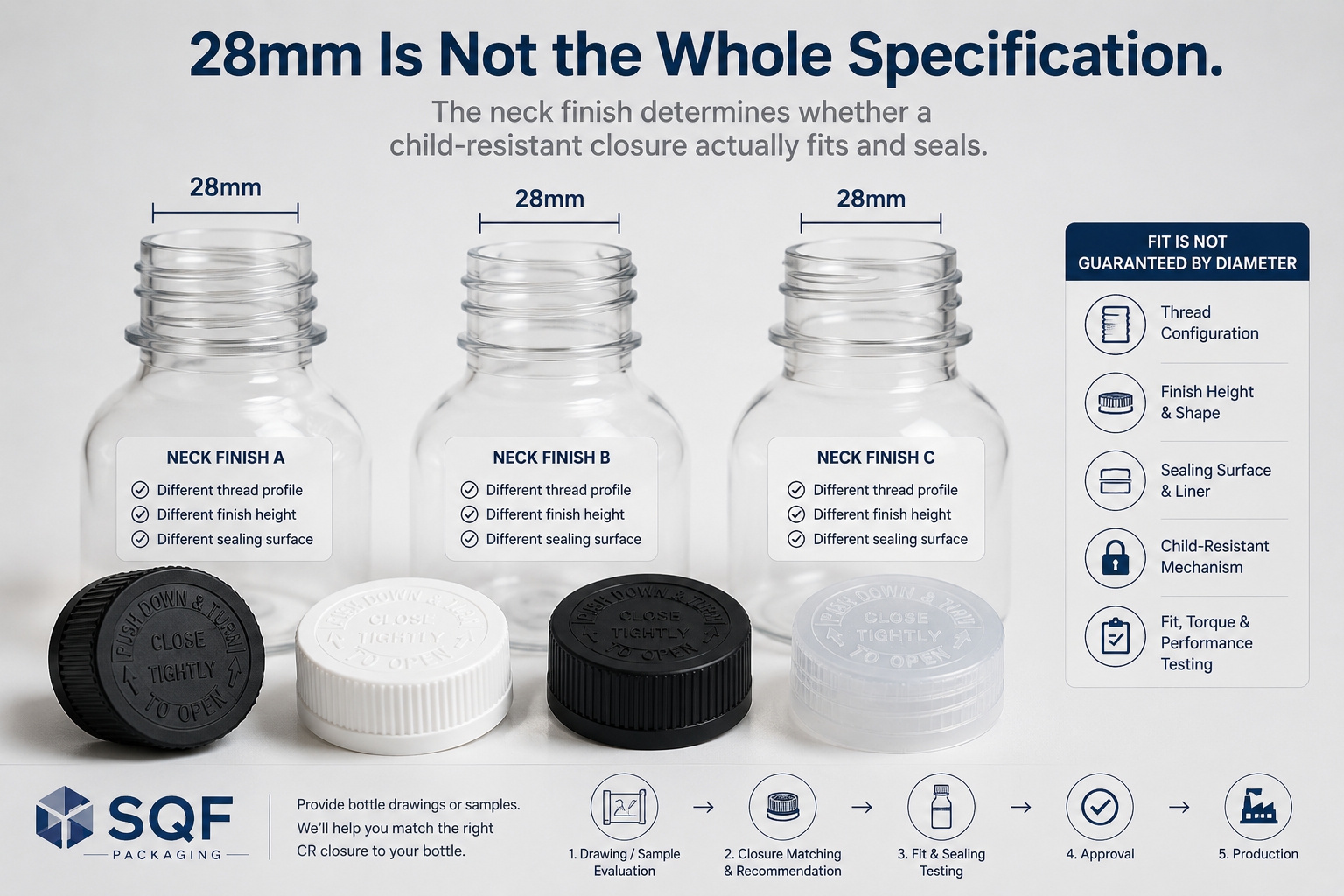
Two bottles can both be described as 28mm and still require different closures. The same principle applies to 20mm, 24mm, 38mm, 53mm and other sizes.
The reason is simple: nominal diameter does not define the complete bottle neck finish.
To determine whether a child-resistant cap will actually fit and seal, we need to look beyond the number.
What Does “28mm CR Cap” Actually Tell Us?
When someone refers to a 28mm cap, the 28mm generally describes the nominal closure or neck diameter.
It does not tell us everything about the interface between the bottle and closure.
The actual neck finish can differ in several important ways, including:
- thread configuration
- finish height
- thread position and geometry
- sealing surface
- inside and outside neck dimensions
- liner and sealing requirements
As a result, two bottles that appear to have the same opening diameter may not accept the same closure.
This is why matching a CR cap by diameter alone can be risky.
What Is a Bottle Neck Finish?
The bottle neck finish is the part of the container designed to engage with the closure.
It includes the neck dimensions, threads and sealing surfaces that determine how the cap fits, tightens and seals.
Packaging drawings may identify these using dimensions such as T, E, H, S and I, depending on the container and closure system.
For buyers, however, the most important principle is straightforward:
Same diameter does not necessarily mean same neck finish.
A closure should be matched to the complete finish specification rather than selected only by nominal size.
Why This Matters Even More with Child-Resistant Closures
A standard screw cap already requires proper thread and sealing compatibility.
A child-resistant closure (CRC) adds another functional requirement: the child-resistant opening mechanism also needs to operate correctly as part of the package.
For a typical push-down-and-turn CR cap, the relationship between the inner and outer closure components, bottle neck and applied position can affect how the package opens and closes.
A closure that appears to screw onto a bottle is therefore not necessarily a properly matched closure.
Fit is only the beginning.
What Should Be Checked When Matching a CR Cap?
When evaluating an existing child-resistant closure for a bottle, we normally look at several areas.
1. Neck Finish and Thread Configuration
The closure thread needs to properly engage with the bottle thread.
Small differences in thread profile, pitch, position or finish height can affect application and removal.
2. Sealing Surface
Where and how the closure seals against the bottle matters just as much as the thread.
A cap can thread onto a bottle and still fail to provide the required seal.
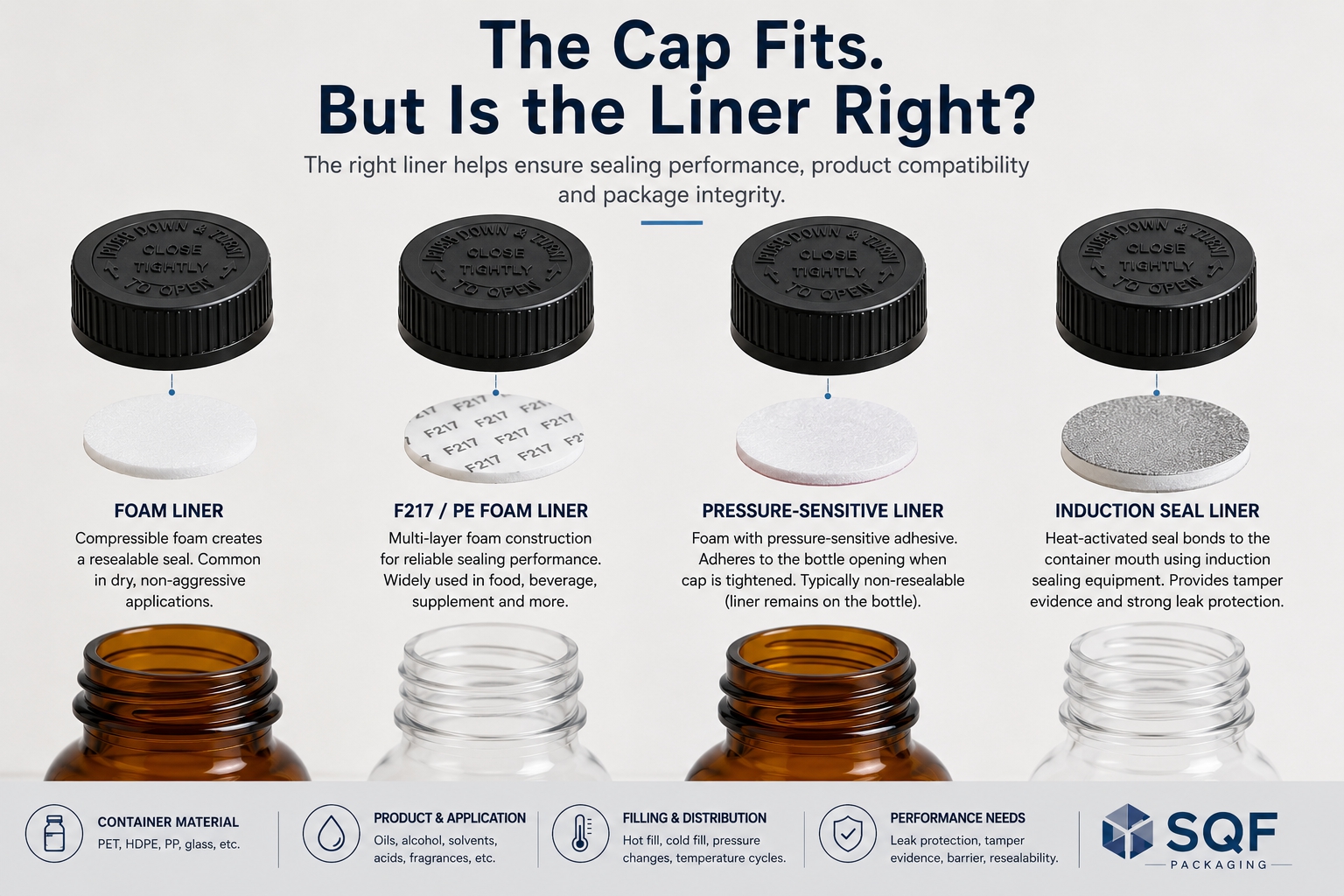
3. Liner or Sealing System
Depending on the application, the CR closure may use a foam liner, induction-seal liner, pressure-sensitive liner or another sealing construction.
The appropriate liner depends on the bottle, product and filling application.
4. Application and Removal Torque
A properly matched closure needs to be applied consistently and still open as intended.
Torque requirements should therefore be considered during packaging evaluation rather than after production begins.
5. Finished Package Performance
Ultimately, the bottle and closure should be tested as a complete packaging system.
Depending on the application, evaluation may include fit, torque, leakage, sealing performance and product compatibility.
The Best Starting Point: A Bottle Drawing
When sourcing a CR closure, one of the most useful pieces of information you can provide is the bottle or neck-finish drawing.
A technical drawing allows the available closure specifications to be compared before samples are produced or shipped.
If the bottle drawing is available, send it.
It can save considerable time.
But drawings are not always available — particularly when working with an existing bottle sourced years ago or supplied by another manufacturer.
In that case, there is another practical option.
No Drawing? Send the Bottle
A physical production bottle can often tell us much more than a simple statement such as “28mm neck.”
The bottle can be measured and compared with existing CR closure options, and potential matches can then be physically evaluated.
Ideally, several representative bottles should be supplied rather than relying on a single sample.
This is particularly useful when the bottle and closure will come from different manufacturers.
Existing Mold First — Custom Tooling Second
Another reason to properly identify the neck finish is that a suitable CR closure may already exist.
Child-resistant closures are available across many sizes and configurations. At SQF Packaging, our current sourcing range includes options across nominal sizes such as:
20mm, 24mm, 28mm, 32mm, 38mm, 44mm, 53mm, 62mm, 68mm and 89mm, depending on the specific neck finish and application.
Before recommending new tooling, we prefer to check available closure platforms first.
If an existing CR cap is compatible, it may provide several advantages:
lower tooling investment, lower initial MOQ, faster sampling and shorter development lead time.
Custom tooling should generally be considered when an existing platform cannot meet the required finish, function, appearance or branding requirements.
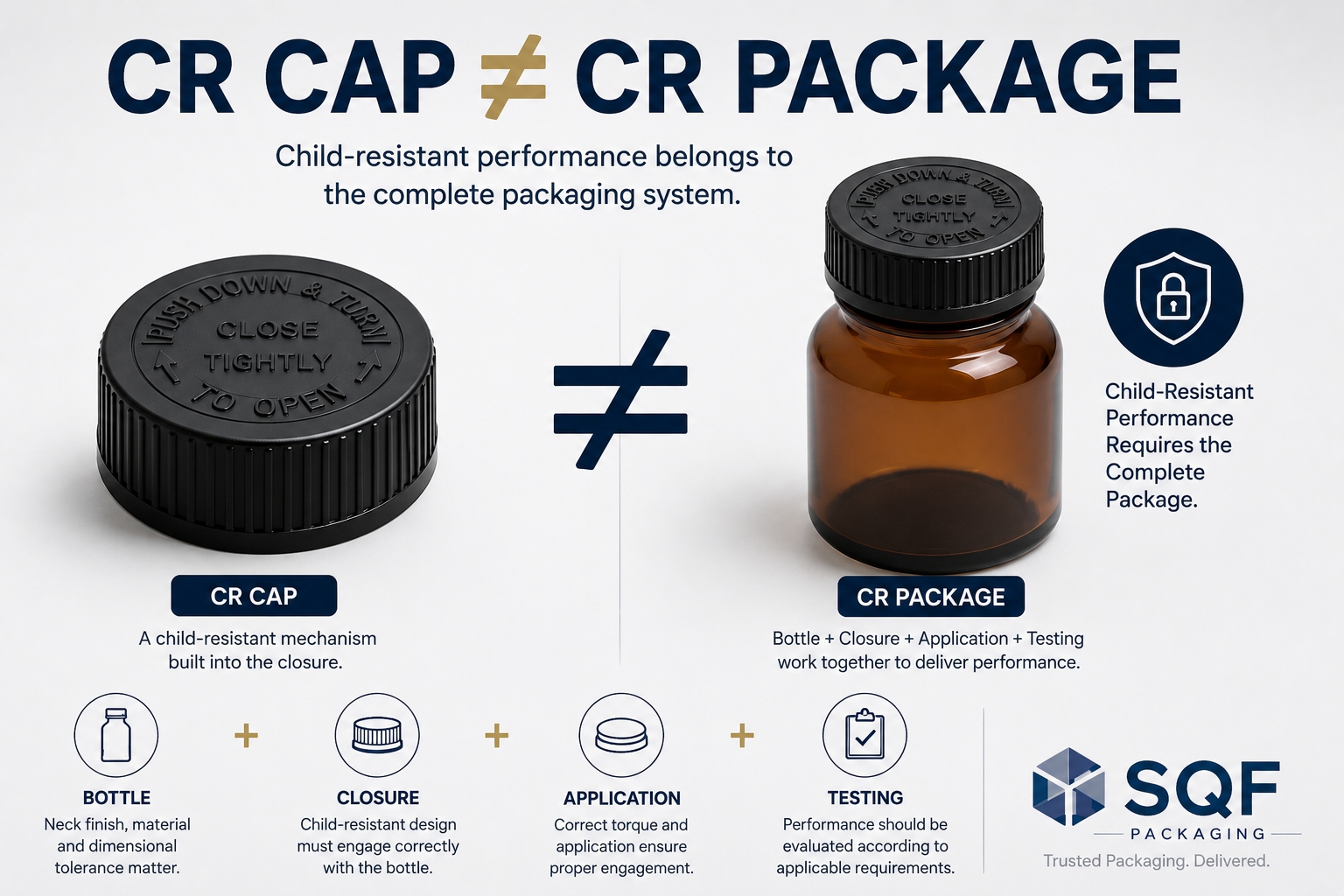
Does a CR Cap Mean the Finished Package Is Child-Resistant?
Not automatically.
This distinction is important.
A cap may use a child-resistant design, but child-resistant performance relates to the complete package, not simply to an individual closure viewed in isolation.
The bottle, closure and their interaction all matter.
Where formal child-resistant packaging compliance is required, the complete packaging system should be evaluated and tested according to the applicable regulations and standards for the intended market and application.
Therefore, sourcing a “CR cap” should not be treated by itself as proof that the finished package is compliant.
A Better Way to Request a CR Cap Quote
Instead of sending only:
“Please quote a 28mm CR cap.”
A more useful RFQ might include:
“We need a child-resistant closure for the attached bottle neck finish. Please review existing closure options. The product is [application], the required liner is [if known], and estimated annual volume is [quantity].”
If the liner is not yet known, that is fine too. Providing information about the application can help determine what sealing options should be evaluated.
The goal is not simply to find a cap with the same number on the specification.
The goal is to find the right closure system for the bottle.
How SQF Packaging Approaches CR Closure Matching
For CR closure projects, we generally follow a simple development path:
Bottle drawing or sample → Closure matching → Fit and sealing evaluation → Approval → Production
This approach allows existing tooling to be evaluated before unnecessary mold investment and helps identify compatibility issues before moving into volume production.
Whether the requirement is a small 20mm closure, a commonly requested 28mm format or a larger 53mm, 68mm or 89mm CR closure, the starting question remains the same:
What bottle neck finish does the closure need to fit?
If you are sourcing a child-resistant closure, send us your bottle drawing or several physical samples together with the application and estimated quantity.
We can start by checking available CR closure options.
FAQ: CR Cap and Bottle Neck Compatibility
Will any 28mm CR cap fit a 28mm bottle?
No. Two bottles can share the same nominal diameter while having different thread configurations, finish dimensions or sealing surfaces. The complete neck finish should be checked before selecting the closure.
How do I identify the correct CR cap for my bottle?
Start with the bottle or neck-finish technical drawing. If no drawing is available, physical production samples can be measured and evaluated against existing closure options.
Can I determine the correct cap by measuring the bottle opening?
Not reliably. A diameter measurement can help narrow the search, but it does not fully describe the thread configuration, finish height or sealing surface.
Does a CR cap need a liner?
It depends on the closure construction, bottle and application. Foam, induction-seal, pressure-sensitive and other liner systems may be considered depending on the required sealing performance.
Can an existing CR cap mold be used for my bottle?
Possibly. Checking existing closure platforms should normally come before developing new tooling. Compatibility still needs to be confirmed against the actual neck finish and application.
Is a CR cap automatically child-resistant compliant?
No. A child-resistant closure design alone does not establish compliance of the finished package. The complete bottle-and-closure system may need to meet applicable child-resistant packaging requirements and testing standards.