CR Cap Liners Explained: How to Choose the Right Liner for Your Product
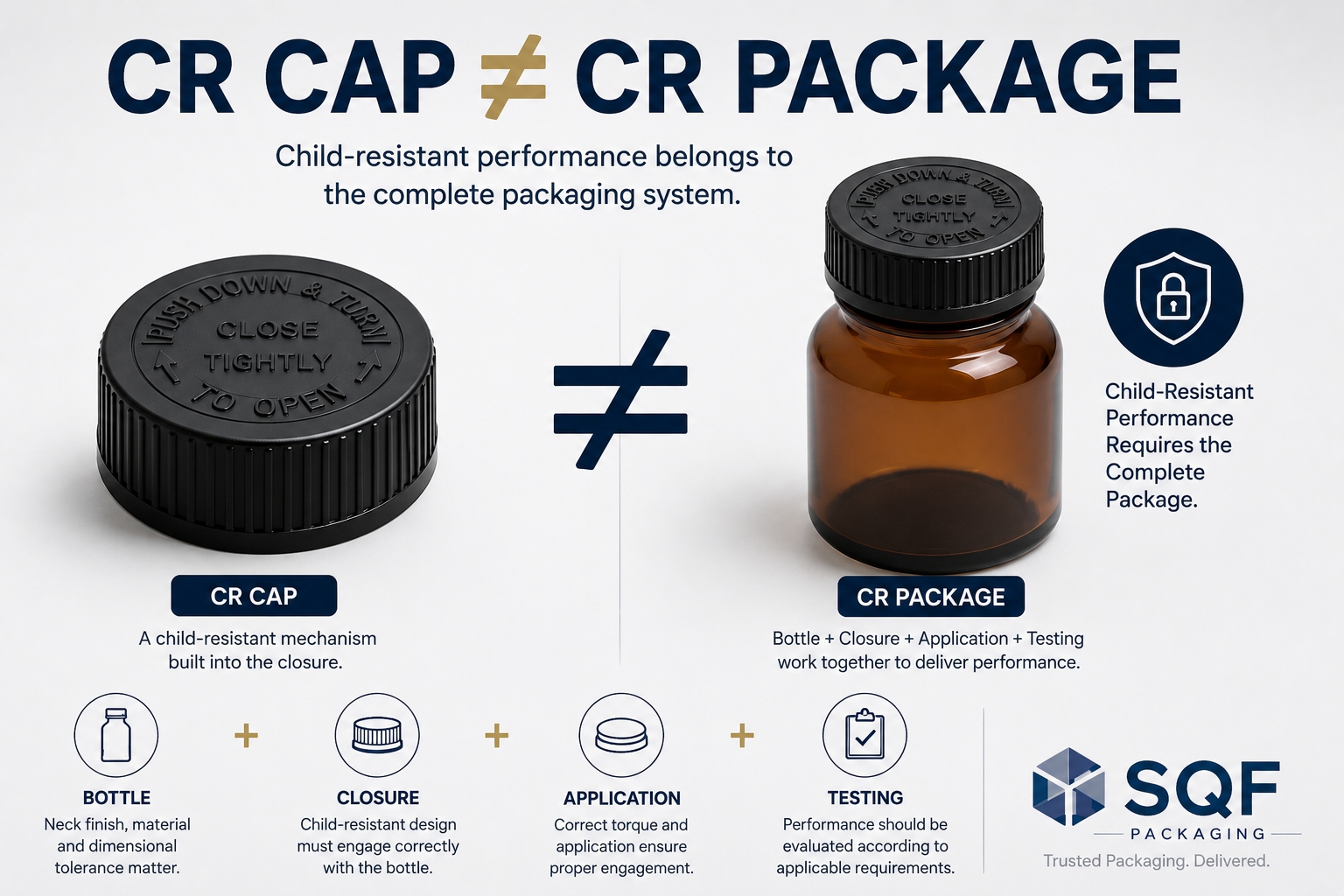
When sourcing a child-resistant closure, most of the attention naturally goes to the cap itself:
What size is it? Does it fit the bottle? Is it push-down-and-turn?
But there is another component that can be just as important to package performance:
the liner inside the closure.
A CR cap can fit the bottle correctly and still have sealing problems if the liner is not appropriate for the container, product or filling process.
That is why liner selection should be considered as part of the complete bottle-and-closure system, rather than as a minor accessory added at the end.
What Does a Cap Liner Actually Do?
A closure liner sits between the closure and the sealing surface of the bottle or jar.
Depending on its construction, it can perform one or several functions, including:
- helping create a seal
- accommodating small variations in the bottle sealing surface
- reducing leakage
- providing additional barrier properties
- supporting induction sealing
- providing tamper-evident functionality
Not every CR closure requires the same liner, and not every liner works with every product.
The correct choice depends on the entire packaging system.
Do All Child-Resistant Caps Need a Liner?
No.
Some closure designs incorporate their sealing function into the closure itself, while others are designed to work with a separate liner.
For lined CR closures, the liner specification should be evaluated together with the bottle neck finish, sealing surface and packaged product.
This is particularly important when the bottle and closure come from different suppliers.
A closure that fits mechanically does not automatically guarantee the required sealing performance.
Common Liner Options for CR Caps
There are many liner constructions available in the packaging industry. The following are some of the types buyers commonly encounter when sourcing plastic closures.
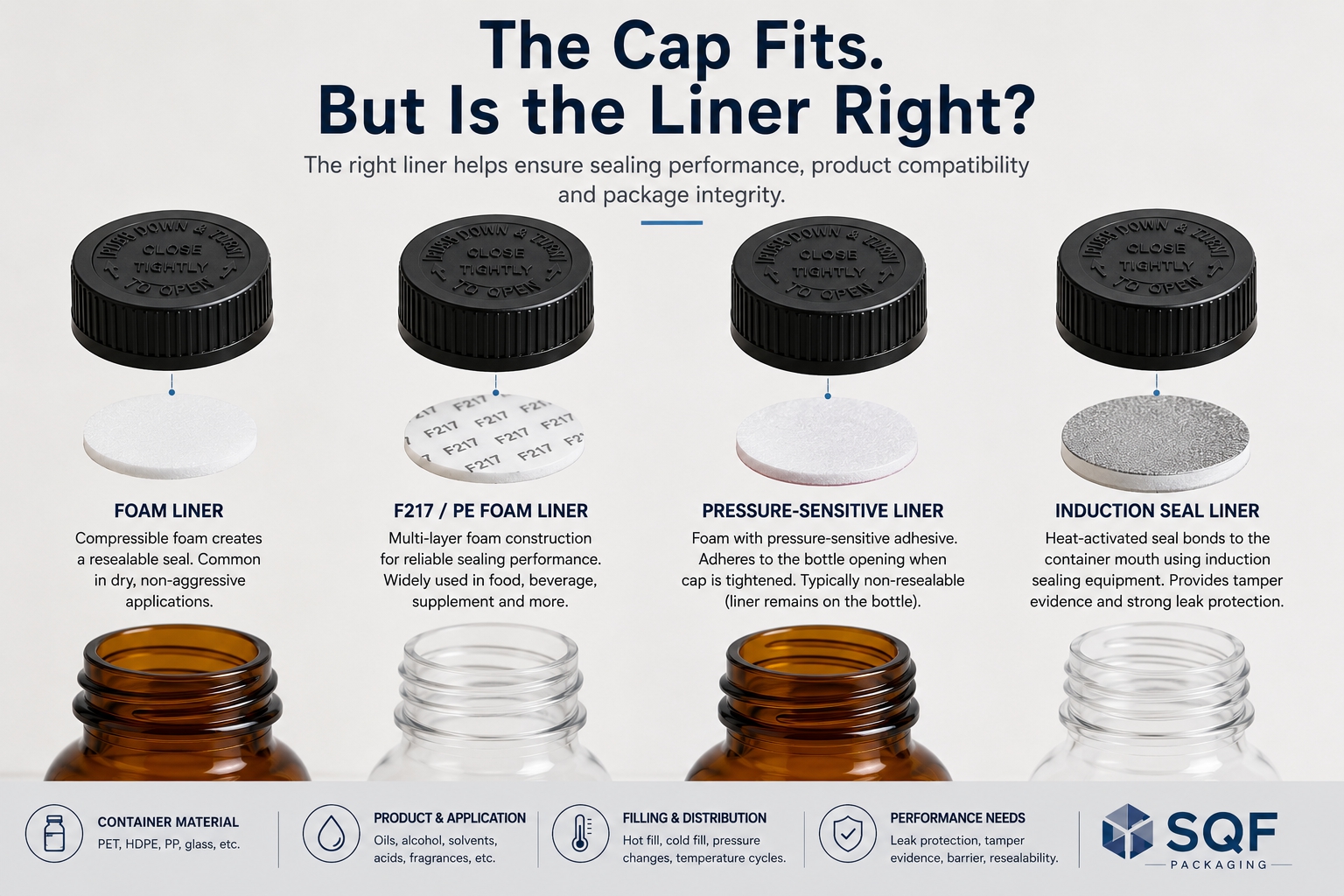
Foam Liners
Foam liners provide a compressible sealing surface between the closure and container.
Depending on the specific construction, they can be used across a wide range of packaging applications.
One commonly encountered family is PE foam-based liners. Another familiar term in the North American packaging market is F217, which generally refers to a multi-layer foam liner construction.
Foam liners are often considered when a resealable closure is required, but their suitability still depends on the product and container.
The term “foam liner” alone is therefore not a complete specification.
Induction Seal Liners
Induction liners are designed to create a seal across the mouth of a compatible container using an induction sealing process.
After the closure is applied, electromagnetic induction heats the foil layer within the liner structure, allowing the sealing layer to bond to the container.
This can provide benefits such as:
tamper evidence, leakage protection and improved package integrity.
However, induction liners are not universal.
The sealing layer needs to be compatible with the container material, such as the specific plastic or glass packaging system being used.
The filling operation also needs suitable induction-sealing equipment and process settings.
Pressure-Sensitive Liners
Pressure-sensitive liners adhere to the container opening when pressure is applied through the closure.
They can be useful for certain dry or non-aggressive products where a relatively simple seal is desired.
However, they should not automatically be treated as equivalent to induction sealing.
Product compatibility, storage conditions and required seal performance need to be considered before specifying a pressure-sensitive liner.
Other Specialty Liner Systems
Depending on the application, other liner constructions may be available for chemical resistance, barrier performance or specialized sealing requirements.
This is one reason why asking simply for:
“a CR cap with liner”
may still leave an important part of the specification undefined.
Foam Liner or Induction Liner?
There is no universal answer.
The better question is:
What does the package need the liner to do?
If the objective is primarily to provide a compressible, resealable interface between the cap and bottle, an appropriate foam liner may be considered.
If the package requires a membrane sealed across the container opening for tamper evidence or additional package integrity, an induction-seal system may be more appropriate.
In some packaging systems, both functions can be incorporated through a multi-component liner structure.
The final choice should be based on the actual application rather than on liner price alone.
Container Material Matters
A liner should not be selected without knowing the container material.
A sealing system intended for HDPE may not necessarily be the correct choice for PET, PP, glass or another substrate.
This is particularly important with induction liners because the heat-seal layer is designed to bond to a particular substrate or family of substrates.
When requesting a liner recommendation, tell the supplier what the bottle is made from.
That one piece of information can eliminate many unsuitable options immediately.
The Product Inside Matters Too
Container compatibility is only half of the equation.
The liner can also be exposed to the packaged product, its vapor or ingredients that migrate into the closure area.
Depending on the application, factors such as these may matter:
- oils
- alcohol
- solvents
- fragrances
- acids or alkaline products
- moisture
- volatile ingredients
A liner suitable for one application should not automatically be assumed suitable for another simply because both use the same bottle and cap.
For sensitive products, compatibility testing with the actual formulation is important.
Don't Specify the Liner Too Early
There is another common sourcing problem:
A buyer receives an existing package specification stating something like:
“28mm CR cap + foam liner.”
It is tempting to reproduce that specification exactly.
But before doing so, it is worth understanding why that liner was originally selected.
Was it selected for leakage resistance?
Chemical compatibility?
Induction sealing?
Tamper evidence?
Or was it simply the standard liner supplied with that closure?
Understanding the function can help determine whether the same construction is actually required for the new package.
What Information Helps Select a CR Cap Liner?
When evaluating a liner, we prefer to know:
Container material — PET, HDPE, PP, glass or another substrate.
Bottle neck finish — ideally supported by a technical drawing.
Product/application — enough information to understand the general compatibility requirements.
Filling process — including whether the product is hot-filled or otherwise requires special processing.
Induction sealing requirement — if applicable.
Performance requirement — such as leakage resistance, tamper evidence or barrier expectations.
Distribution conditions — especially when the package may experience temperature changes, pressure changes or long transportation cycles.
You do not necessarily need to provide a complete proprietary formulation at the beginning of a sourcing project.
Often, understanding the general product category and relevant compatibility concerns is enough to begin narrowing down suitable options.
Fit, Seal and Product Compatibility Should Be Evaluated Together
A CR packaging system should not be developed as three separate components:
bottle + cap + liner
It is better to think of them as one system:
bottle × closure × liner × product
Changing any one of these variables can affect package performance.
For example, changing the bottle supplier while keeping the same nominal neck size may alter the sealing surface slightly.
Changing the liner may affect application torque or sealing performance.
Changing the product formulation may introduce a new compatibility concern.
This is why samples and testing remain important even when all individual components appear correct on paper.
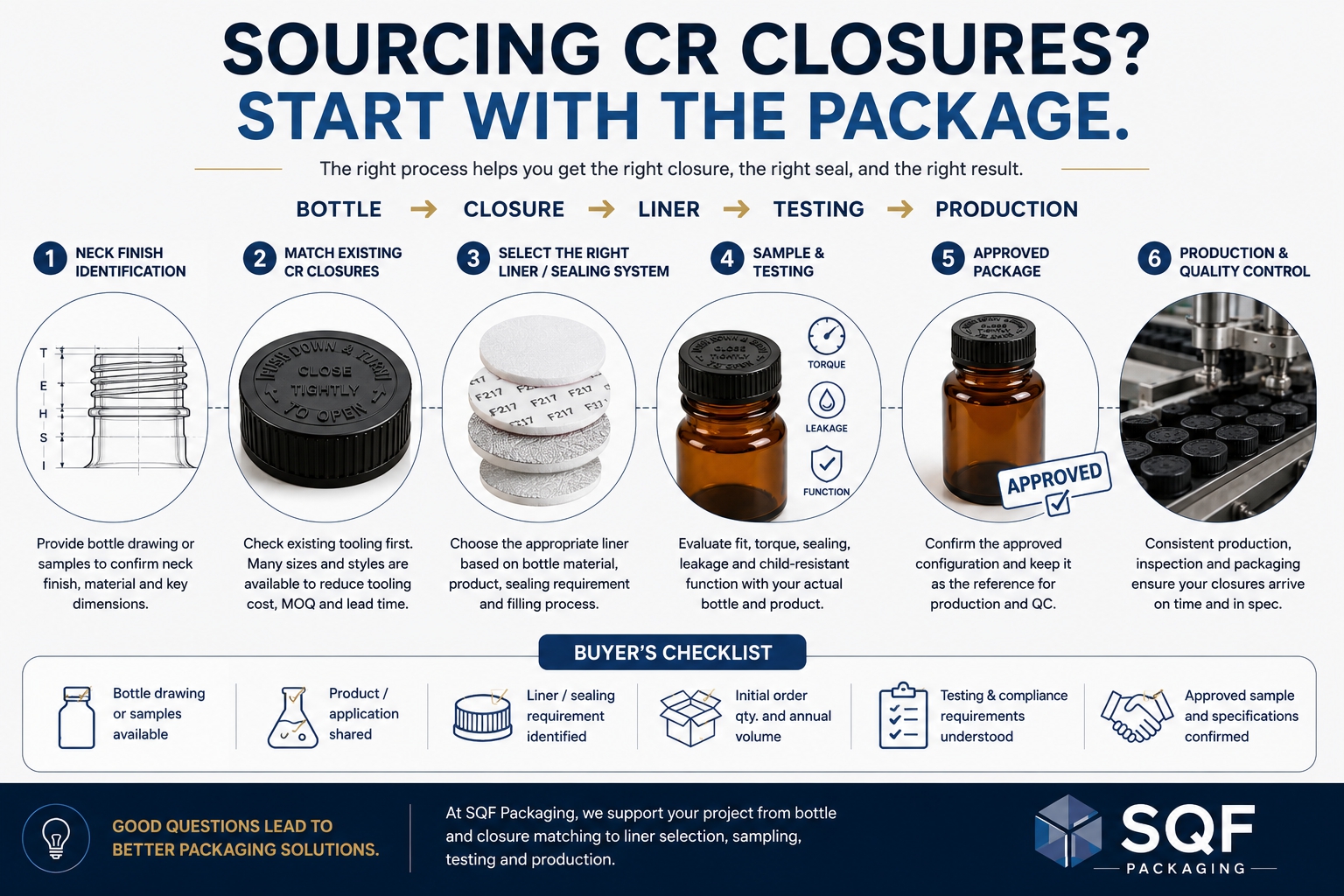
A Practical CR Closure Development Sequence
At SQF Packaging, a typical CR closure evaluation can begin with:
1. Identify the bottle and neck finish
Confirm the container material and technical dimensions.
2. Match an existing CR closure
Check available tooling before considering a new mold.
3. Select the sealing system
Evaluate liner options according to the container and application.
4. Produce or provide samples
Test the actual bottle, closure and liner together.
5. Evaluate package performance
Review fit, torque, leakage, sealing and relevant product compatibility.
6. Approve before production
Keep an approved package configuration as the production reference.
This sequence helps prevent a common sourcing mistake: selecting each packaging component independently and discovering the compatibility problem only after production.
The Liner Is Small. Its Role Isn't.
A liner may be one of the least visible components of a child-resistant package.
But when leakage, sealing or product compatibility becomes a problem, it can suddenly become one of the most important.
So when sourcing your next CR closure, don't stop at:
“What size cap do I need?”
Also ask:
“What sealing system does this package need?”
At SQF Packaging, we can evaluate CR closure options together with the bottle neck finish, liner requirement and intended application to help identify a practical packaging configuration before production.
FAQ: CR Cap Liners
What liner should I use for a child-resistant cap?
There is no universal liner for CR caps. The appropriate liner depends on the bottle material, neck finish, packaged product, filling process and required sealing performance.
What is an F217 liner?
F217 commonly refers to a multi-layer foam liner construction used in plastic closures. The exact specification and product compatibility should still be confirmed with the liner or closure supplier.
Can I use an induction liner with a CR cap?
Potentially, yes. The closure needs to accommodate the appropriate induction liner, and the sealing layer must be compatible with the container material and induction-sealing process.
Is a foam liner the same as an induction liner?
No. A foam liner generally provides a compressible sealing interface, while an induction liner is designed to create a seal across the container opening through an induction-sealing process.
Can the same liner be used for PET and HDPE bottles?
Not automatically. Particularly with induction sealing, the sealing layer needs to be compatible with the container substrate. The actual liner specification should be confirmed.
Do I need to provide my full product formula to select a liner?
Not necessarily at the initial sourcing stage. General information about the product category, container material and relevant compatibility concerns can often help narrow down options. More detailed compatibility evaluation may be required before final approval.